Anatomy of the Auditory System
- The ear can be divided into three sections: the outer ear, the middle ear, and the inner ear.
- The outer ear includes the:
- pinna: visible part of the ear that protrudes from our heads.
- auditory canal: connects the ear to the outside world.
- tympanic membrane: also called the eardrum.
- The middle ear includes the three tiny bones known as ossicles:
- malleus/hammer
- incus/anvil
- stapes/stirrup
- The inner ear contains:
- semicircular canals: involved in the sense of balance and movement
- cochlea: fluid filled, snail shaped structure that contains the sensory receptor cells for the auditory system
- The outer ear includes the:
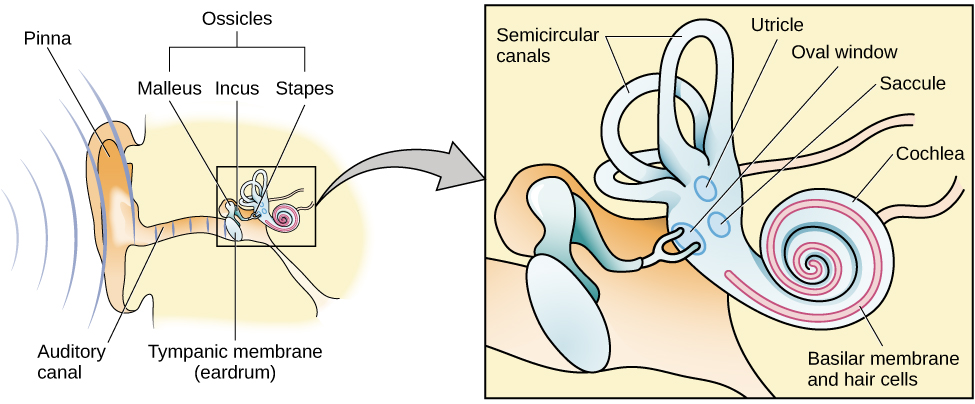
The Mechanics of Hearing
- Sound waves travel along the auditory canal and strike the tympanic membrane.
- This causes the eardrum to vibrate.
- The movement of the eardrum results in the movement of the ossicles.
- As they move, the stapes presses into a thin membrane in the cochlea.
- This thin membrane is called oval window.
- The movement of the oval window allows fluid in the cochlea to move.
- Movement of fluid in the cochlea stimulates the hair cells inside.
- These hair cells serve as the auditory receptor cells.
- They are embedded in the basilar membrane.
- It is a thin strip of tissue within the cochlea.
- Movement of fluid in the cochlea stimulates the hair cells inside.
- When hair cells activate, they send neural impulses along the auditory nerve that get sent into the brain.
- Auditory information is transported back and forth to the inferior colliculus, the medial geniculate nucleus of the thalamus, and finally to the auditory cortex in the temporal lobe for processing
- Some evidence suggests that auditory recognition and localization is processed in parallel, just like in the visual system.
Pitch Perception
- Different theories are proposed to describe pitch perception.
- The two most important ones are temporal theory and place theory of pitch perception.
Definition
Temporal Theory of Pitch PerceptionIt states that our perception of pitch depends on the activity of the sensory neuron.
- This indicates that depending on the frequency of the sound wave, a hair cell would fire action potentials related to the frequency of that particular sound wave.
- However, note that there are limitations of the frequency of the action potentials themselves.
- This is because the range of frequencies we detect (
) is broad enough that the frequency of action potentials can’t account for the entire range.
Definition
Place Theory of Pitch PerceptionIt states that different portions of the basilar membrane are sensitive to different frequencies.
- The base of the basilar membrane responds best to high frequencies.
- The tip of the basilar membrane responds best to low frequencies.
- Both of these theories explain different aspects of pitch perception.
- At frequencies of up to
, the place and the rate of action potentials contribute to the perception of pitch. - For frequencies above
, sounds can only be encoded with place cues.
- At frequencies of up to
Sound Localization
-
We rely on cues that provide information that help us to localize (locate) sound.
- Cues that rely on one ear are called monaural.
- Cues that rely on both ears are called binaural.
-
Depending on the source of the sound relative to our bodies, each pinna interacts with these incoming sound waves differently.
- This provides us a monaural cue yo locate sounds above, below, in front, or behind you.
-
If the source of the sound came from either left or right, the differences in the vibration that each ear receive can allow us to determine the location of the sound source.
- Interaural level difference is the difference in the intensity of the sound that one ear receives compared to the other.
- This happens when a sound wave comes as more intense in one ear than the other.
- Interaural timing difference is the difference in the time it takes for a sound wave to arrive to one ear compared to the other.
- This happens when a sound wave reaches one ear first before the other.
- Interaural level difference is the difference in the intensity of the sound that one ear receives compared to the other.
-
When our brains discern differences in the intensity perceived and the time when a sound wave arrives in either ear, it allows us where (left or right?) a sound is located.
-
The use of both ears to localize sound this way is a binaural cue.
Hearing Loss
- Deafness is the partial or complete inability to hear.
- There are three main types of deafness: congenital, conductive, sensorineural.
- Congenital deafness is a condition when a person is born without a sense of hearing.
- People with conductive hearing loss suffer problems in delivering sound energy to the cochlea
- Some common causes are:
- a blockage of the ear canal
- a hole in the tympanic membrane
- problems in the ossicles
- fluid between the eardrum and cochlea.
- Some degree of conductive hearing loss is inevitable due to the mechanical nature of the sound wave stimulus.
- These are often dealt with devices that amplify sound waves so that vibration and movement in the eardrum and the ossicles are more likely to occur.
- Some common causes are:
- Sensorineural hearing loss is when the hearing problem is associated with the failure to transmit neural signals from the cochlea to the brain.
- It can be caused by many factors such as:
- head or acoustic trauma
- environmental effects like noise exposure
- aging
- infections, diseases, tumors, or toxins
- some medications
- People with this kind of hearing loss may be candidates for cochlear implants
- Cochlear implants are electronic devices that consist of a microphone, a speech processor, and an electrode array.
- This device receives incoming sound and directly stimulates the auditory nerve to transmit information to the brain.
- It can be caused by many factors such as: