Plate Tectonics
Plate Tectonics
- It is a theory that describes the structure of the Earth’s crust.
- It states that the Earth’s crust is divided into large pieces of rigid lithospheric plates.
- These plates float over molten hot material over the asthenosphere.
- This allows convection currents from the mantle to move the plates.
- In the boundary between two plates are said to be a place where most igneous and metamorphic processes occur.
Plate Boundaries
Plate Boundary
- It is a place where two different plates meet.
- According to the Plate Tectonic theory, most geological features and rock processes form on the regions where plates meet.
- There are three different types of plate boundaries: divergent, convergent and transform/lateral
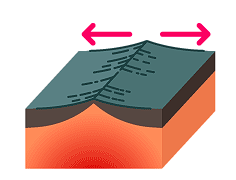
Divergent Plate Boundary
- A plate boundary where two plates move away from one another.
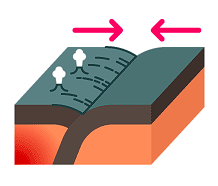
Convergent Plate Boundary
- A plate boundary where two plates move toward each other.
Lateral/Transform Plate Boundary
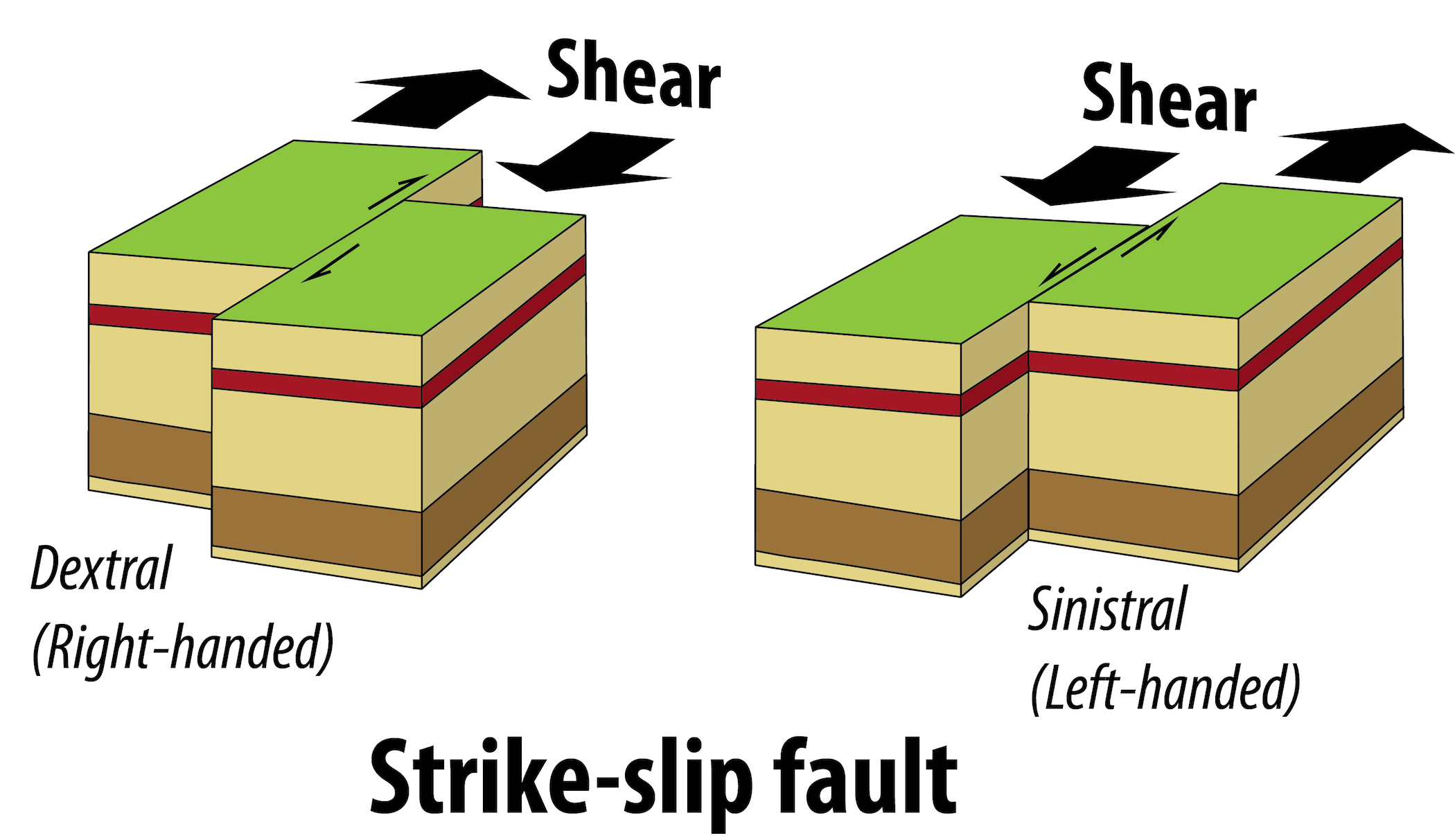
- A plate boundary where two plates move past one another.
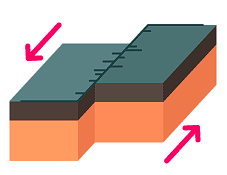
- There are two types of lateral or transform plate boundaries: left lateral (sinistral) or right lateral (dextral)
Rock Dating
Rock Dating
- It is a process of finding the age at which a rock started to form.
- There are two types of rock dating methods: relative dating and absolute dating.
Relative Dating
- It is a process of arranging geological events based of the sequence of rocks.
- Here, the age of a rock is determined by comparing it to an another rock with a known age.
- This type of rock dating can be hugely inaccurate.
- This is because they are made from educated guesses
- The process of relative dating is based upon the three Steno’s Laws.
- Law of Original Horizontality
- It states that some sediments layer themselves horizontally due to the force of gravity.
- When deformation arises in horizontally layered sediments, this is due to geological processes such as faulting, tectonic plate movement, or volcanic activity.
- The amount of deformation from the horizontal layering of the rock may indicate how old a rock is.
- Law of Superposition
- It states that for an undisturbed rock sequence, the oldest rocks lie at the very bottom, while the newer sediments form at the top.
- This is because it is not possible for sediments or rocks to slip beneath a layer already deposited.
- Law of Cross-cutting Relationships
- It states that a geologic feature that cuts an another geologic feature is the youngest between the two.
- Law of Original Horizontality
Absolute Dating
- It uses radioactivity to determine the exact age of a rock.
- During the formation of the rock, some radioactive atoms may get trapped inside as it cools.
- When certain radioactive elements decay, they also leave trace elements, known as decay pro that are a byproduct of that process.
- The time of the decay process is something that geologists can accurately calculate.
- The percentage of radioactive atoms decayed into trace elements determines the age of the rock.
- Geologists use these three types of radiometric dating that can be applied to accurately determine a rock’ age.
- Radiocarbon Dating
- most often used in fossils and organic rocks
- can be used on rocks between 100-50,000 years.
- plants naturally contain a form of radioactive carbon called
. - animals also get radioactive carbon by feeding on to plants.
- as plants and animals die, they stop exchanging carbon in the environment.
- eventually, the amount of carbon decreases as
decays. - the amount of remaining
atoms remaining determines the age of the rock
(Potassium-Argon) Dating - uses the decay product of radioactive potassium to find the age of a rock.
- it can be used to determine the age from
years to over a billion years old - potassium is a common element in many minerals
- one isotope of potassium,
decay into atoms - these
atoms can easily leave liquid, molten rock. - but, as the rock cools,
atoms begin to accumulate inside.
- but, as the rock cools,
- the ratio of accumulated
versus the remaining determines the age of the rock.
- one isotope of potassium,
(Uranium-Lead) Dating - uses uranium and its decay of lead to find the age of the rock
- the oldest and most refined radiometric dating schemes to date.
- when zircon crystals form, they accept uranium and thorium atoms inside, but not lead atoms.
- therefore, any presence of lead inside the rock must come from the decay of uranium.
- this can be used to accurately determine the age of the rock
- it utilizes two types of decay chains:
, which can date rocks up to billion years , which can date rocks up to million years.
- Radiocarbon Dating
Geologic Time Scales
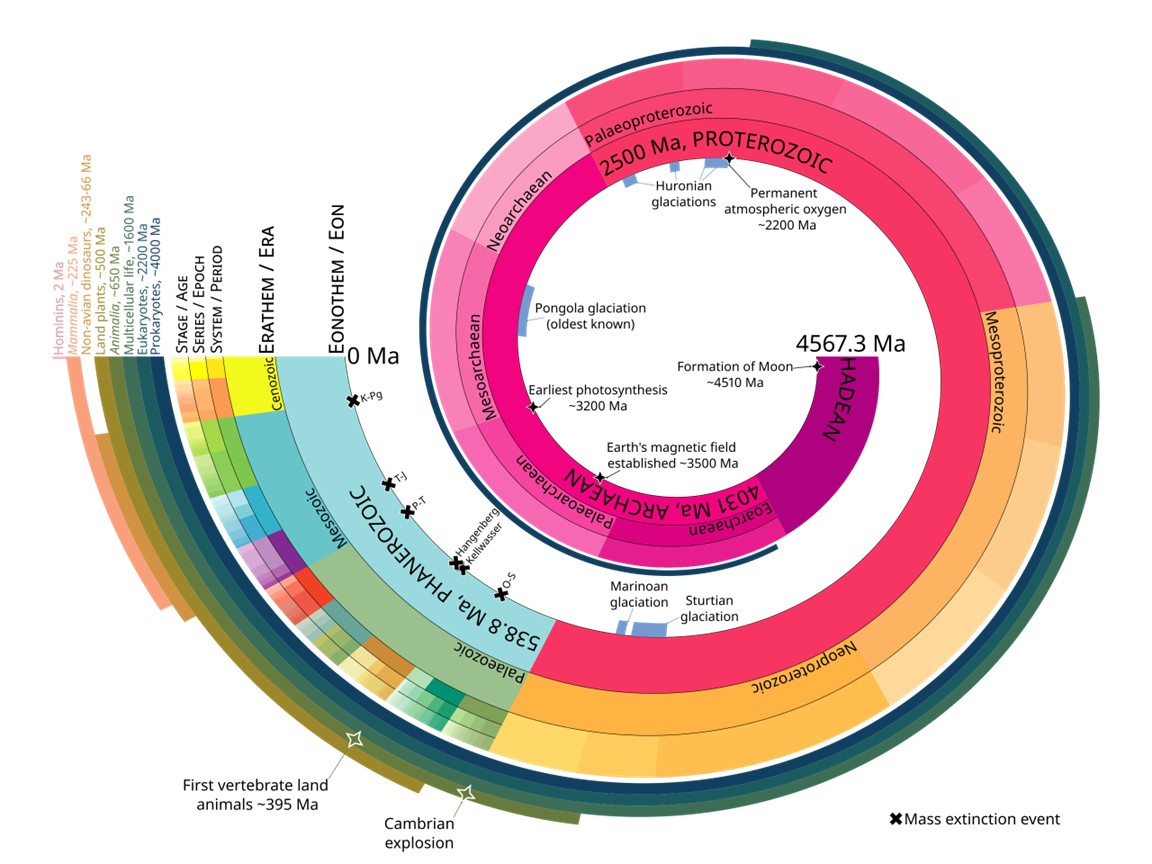
Geological Time Scale
- also known as geologic time scale
- it is a representation of time based on the geologic record of the Earth
- through the invention of rock dating methods, geologists were able to determine the events in Earth’s history by examining rocks and fossils.