Objectives
- Rewrite algebraic combinations of rational expressions
- Verify a solution to a rational equation
- Solve a rational equation with one or more solutions.
- Define what is an extraneous solution
- Solve a rational equation containing an extraneous solution.
- Reason why division by zero is undefined.
Review: Rational Expressions
- A rational expression is an expression that involves at least a single variable inside the denominator of a fraction.
- Here are some examples of rational expressions.
Operations involving Rational Expressions
- Like polynomial expressions, rational expressions can also be added, subtracted, multiplied or divided together.
Multiplying Rational Expressions
- To multiply rational expressions together, we only multiply the numerators together, then we multiply the denominators together.
- For example:
Worked Example
Multiplying Rational Expressions without FactoringSimplify the following rational expressions.
Solution
- When simplifying factors this way, we often introduce cases where we reduce the fraction to its lowest term, such as the case like this:
- This is because, we have similar factors in the numerator and the denominator.
- By rewriting the expression like this, we see that upon regrouping, some factors in the denominator and the numerator reduce to
- This also applies to rational expressions.
Worked Example
Multiplying Rational ExpressionsSimplify the rational expressions.
Solution
For
, we can simply cancel out binomials since it is already written out in factored form.
We must first make sure that we do not miss anything therefore, we still need to factor everything.
Dividing Rational Expressions
- When dividing rational expressions, we use the stay, change, flip method.
- For instance, consider the rational expression:
- To divide, we:
- keep the dividend (the first value).
- change the operation to multiplication.
- flip the divisor (the second value)
- Then, we multiply like we normally do:
- Just like in multiplication, you can cancel any similar factors in the numerator and the denominator to simplify your answer.
Worked Example
Dividing Rational ExpressionsSimplify the following rational expressions.
Solution
We use the stay, change, flip rule to divide these rational expressions.
However, any like factors in both the numerator and the denominator should be cancelled to keep our quotient in lowest term.
As for
, we use the idea that fractions and division are related
Any fraction in the formcan be rewritten as .
Proof
The Intuition behind Keep, Change, Flip MethodTo see why this method works, consider this expression.
We know from before that a fraction can represent a division of two numbers.
We can rewrite this expression as:The bottom expression can be cancelled, and thus the denominator simplifies to
. By expressing the left-side of the equation as a division of two fractions, we get:
Here, we find the first value (the dividend) kept as is, the sign now changed to multiplication, and the second value (the divisor) flipped.
Since these two expressions were equivalent, therefore dividing two fractions is the same as keeping the dividend, changing the sign, and flipping the divisor.
Adding and Subtracting Rational Expressions
- The process for adding and subtracting rational expressions is a tricky process.
- Therefore, we divide this section into adding and subtracting rational expressions with similar denominators and dissimilar denominators.
Similar Rational Expressions
- Two rational expressions are similar is they share the same denominator.
- For instance, these fractions are similar as they both have the denominator
- For instance, these fractions are similar as they both have the denominator
- We can only add and subtract rational expressions when both denominators are the same.
- If that is the case, we add/subtract the numerators, then keep the denominators
Worked Example
Adding and Subtracting Rational Expressions with Similar DenominatorsSimplify the following expressions.
Solution
For
For
Dissimilar Rational Expressions
Work in Progress!
The content beyond this section contains some missing information that might be essential in fully understanding the topic.
- If the denominators aren’t the same, such as this expression, they are said to be dissimilar
- One strategy when adding or subtracting dissimilar fractions is to rewrite the expression so that they have the same denominator.
- We can do this by multiplying the expression by
- Notice that we had to multiply the expression on both the numerator and the denominator.
- This is so that the top and the bottom cancels out and we are simply multiplying by 1
- Instead of canceling, we use the distributive property to distribute
into the individual terms.
- We can then cancel factors present in both the numerator and the denominator.
- Now that both denominators are the same, we can now add them normally.
-
The expression we multiplied at the start,
, is called the least common denominator. - Finding the least common denominator is essential in adding or subtracting dissimilar rational expressions.
-
When finding the least common denominator, for instance, in the expression below.
- We first have to ensure that each denominator is in factored form.
- Then, for each rational expression, we list the factors of their denominators.
-
To find the LCD, we simply have to multiply all unique factors from each denominator.
- Therefore, the LCD is
.
- Therefore, the LCD is
-
Note that we heavily emphasize on the keyword unique.
-
This is because if we want to get the LCD for a rational expression like:
- Then, we would list the factors of each denominator like this:
-
Since the factor
appears in more than two denominators, then we only count the factor once. - Therefore, the LCD is only
- Therefore, the LCD is only
-
However, consider this following rational expression:
- Factoring the denominator, we get:
- If we list the factors in each denominator, we get:
- Since the factor
appears in either denominator, then we only count this factor once. - However, since we
Worked Example
Adding and Subtracting Rational ExpressionsSimplify the following rational expressions.
Solution
For
, we can simply cross-multiply each denominator. For
, we multiply each term such that we have one of each factor in the denominator For
, make sure to factor each denominator first. For
, factor each denominator. Consider the multiplicities of each factor in finding a common denominator.
Rational Equations
- A rational equation is an equation involving one or more rational expressions.
- One such example is the equation below:
- Our goal here is to find a value for
where the expression on the left and the right are equal.
Definition
Rational EquationA rational equation is an equation that contains at least a single rational expression.
-
Rational equations can be solved in a way that they can be turned into ordinary polynomial equations.
- For instance, take the rational equation below:
- The first step is to multiply each side by
. - This cancels the
term in the denominator.
- Now, this can be solved as a linear equation.
- By substituting this value to our original equation, we see that it satisfies our equation.
-
When solving rational equations, we’d often find values that we’d normally get from solving, but are not necessarily part of the solution set.
- These are called extraneous solutions, and they will be discussed in more detail in the next section.
- In general, if we obtain any value from solving, make sure to verify it by substituting it back to the original equation.
- If it results in any form of division by zero, then it is not part of the solution set.
- Otherwise, it is part of the solution set if both expressions on the left and right of the equation are equal.
Worked Example
Verifying Solutions in Rational EquationsVerify whether if any given values below is part of the solution set for the given equation below.
Solution
We can just simply substitute each value inside the equation and look for certain values that satisfy the equation.
- When
:
- When
:
- When
: Since
involves a division by zero, therefore it is an extraneous solution and it does not belong to our solution set. However,
is the only value where both expressions are equal, therefore belongs to our solution set.
- Some rational equations that have two or more rational expressions can be solved in two different ways.
- You can manually try to find the LCD, then multiply both sides of the equation by it.
Each rational expression in the equation simplifies into a polynomial equation that can be solved algebraically.- You can also group each term on one side of the equation, then add them together.
Then, by multiplying by the resulting denominator, we can see that the equation also simplifies into a polynomial expression.
- You can also group each term on one side of the equation, then add them together.
- Here, we can see that these two statements are equivalent by directly transposing them.
- You can manually try to find the LCD, then multiply both sides of the equation by it.
Worked Example
Solving Rational Equations that Result in a Linear EquationSolve the following rational equations.
Solution
For
, one rule to consider is to find all denominators in the equation, then multiply both sides by its least common denominator.
For
, here we added the two expressions instead, then multiplied by their denominator.
- If we instead have a variable on both the numerator and the denominator, rewriting the equation might eventually end up as a quadratic equation.
Worked Example
Solving Rational Equations that Result in a Quadratic EquationSolve the following rational equations:
Solution
For
, we can group each rational expression in the equation then add them using techniques from the previous section.
Next, we use the quadratic formula.
We then use the quadratic formula.
Extraneous Solutions
- An extraneous solution is a value that is obtained from the normal solving process that is not part of the solution set for the equation.
- Consider the following equation:
- Solving this would give us:
- However, by substituting this solution to the equation, we get:$$
\begin{align*}
\frac{1}{3-3}&=1+\frac{1}{3^{2}-5(3)+6}\
\frac{1}{0} &= 1 + \frac{1}{0}
\end{align*}
- However, by substituting this solution to the equation, we get:$$
- Since division by zero is undefined, therefore
is not a solution to the equation.
This means that this equation does not have any solutions.
Worked Example
Solving Rational Equations with Extraneous SolutionsSolve the following equations. Verify if the values obtained is included in the solution set.
- $\dfrac{1}{x^{2}-3x+2}=\dfrac{-x}{x-1}$$
Checking our solution, we get:
Since division by zero is undefined, then this equation has no solutions.
Checking our solutions, we get:
- When
: Since division by zero is undefined, then
is not part of the solution set.
- When
: This indicates that only
is only included in the solution set.
- One way to know whether what values to look for on a rational equation in case of extraneous solutions is to look no further than in the denominator.
- Consider the following equation:
- Since we don’t want to divide by zero, we need to look in the denominator what values will make it equal to
. - The denominator
is equal to zero when . - The denominator
will never equal zero as it is a constant. - However, the denominator
is equal to zero when .
- The denominator
- Therefore, if you obtain values from solving that are either
, then it is an extraneous solution. - We will also discuss this much deeper when we dive in the Domain and Range of a Rational Function
Proof
Division by ZeroWe previously established that any number divided by zero is undefined. However, there’s not much explanation as to why this is the case.
In this section, we will explore why division by zero is undefined by reasoning on what we already know and making connections about the properties of rational functions and the division operation in general.
Division as Repeated Subtraction
The concept of multiplication came from repeated addition. For instance, if we have a statement like
, then we can express that as: However, since division is the inverse operation of multiplication, we can use the product (the answer to multiplication)
, and divide it to any of its factors: or . By doing so, we get the other factor used in the multiplication process.
However, by establishing that multiplication is repeated addition, we can also say that division can be expressed as repeated subtraction.
Here, the quotient (the answer in division) is how many times can you subtract a factor before it reaches zero.
But what if we divide by zero?
Here, no matter how many zeroes we subtract, we will never reach zero whatsoever.Therefore, this interpretation does not provide a conclusive answer.
Also, by saying that division is repeated subtraction is inaccurate as it doesn’t include cases where natural numbers can’t be evenly divided.Division by Zero through a Limiting Process
One way we can tackle the division by zero problem is by using a concept of a limiting process.
This is when we use numbers that get closer to zero to evaluate the value of.
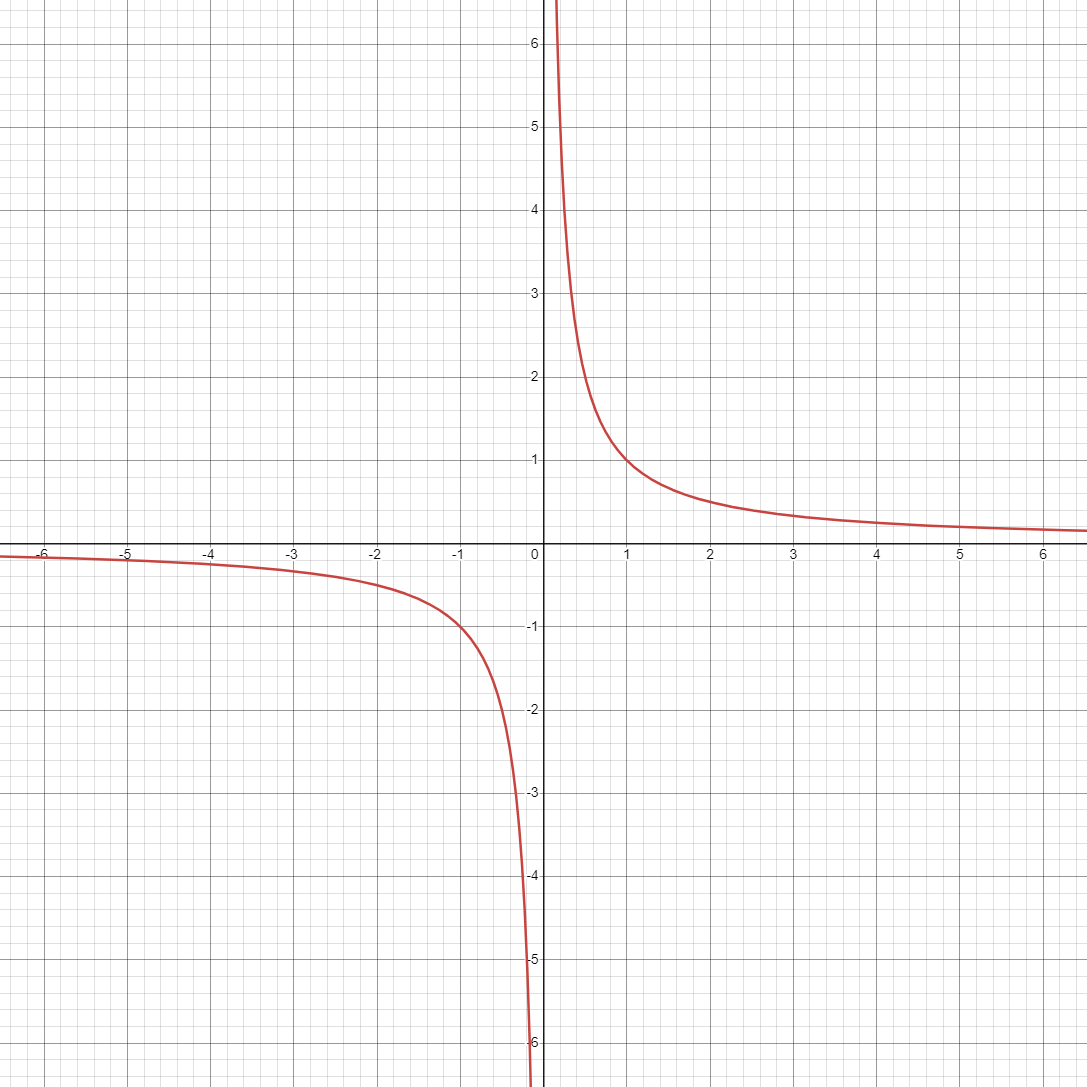
We can use a table to demonstrate.We see that as we get closer to zero, the resulting value gets unboundedly large.
Therefore, from this assumption, we can say that:However, this isn’t clear either as if we approach
from instead, we get different results. This time, we are not approaching
. Instead, we are approaching .
From here, we can now see that it is still inconclusive as we can’t conclusively determine whetheris or . For comparison, we can plot the graph for the table of values from before and it gives us the standard graph of the rational function, which we’ll explain in-depth later.
as the Multiplicative Inverse of A multiplicative inverse of a number
is a unique number where times its inverse is equal to . This multiplication property simply says that any number, except
, has an inverse that fits this property. For instance, the numbers (in magenta) and their inverses (in orange) are multiplied by their inverses In general, any real number
has a multiplicative inverse in the form of .
However, zero does not have a multiplicative inverse. There is a reason for it.Suppose that we define the multiplicative inverse of
as .
Therefore, from the properties of division and multiplication, we get the following properties.From this property, we use
, then add on both sides. In the left side, we rewrite
as because of the property above. By using distributive property, we can rearrange this equation.
Upon evaluating the rewritten form, we can a paradox.Upon letting
be the multiplicative inverse of , we found that we could produce statements that would otherwise be false or nonsensical to our normal world of numbers. In the next section, we would clearly see the implications why division by zero is impossible, and what would happen if we try to make it possible.
Division by Zero from Zero Product Property
“Any number multiplied by zero is always zero.”
This statement is called the zero product property and one of the first properties we learn in multiplication.From this statement, we see that:
Since any number multiplied by
is , we can say that: If we allow division by zero, and that the properties of division to also apply to zero, we can again divide both sides by zero to get:
Here, we get the same paradox from before except that the implications of this is that any number we choose can be equal to anything else, and this can only be possible if every number is equal to
. Conclusion
From the arguments that we presented, we conclude from here that division by zero remained undefined because allowing it seems to break our normal way of how numbers apply to our real world.
In addition, while mathematicians have tried dividing by zero, they too have not succeeded as in doing so, properties that emerge from this assumption appear to contradict to our understanding of math in general and how can it be useful for everyone.
- Before concluding this section on solving rational equations, this is a general step-by-step instruction on how to solve rational equations.
Tip
Solving Rational Equations
- Factor any denominators first.
- Find values where the denominator of a rational expression is equal to
.
- These are the ones that you want to avoid and look for.
- Solve the rational equation either through any of the following methods:
- Transpose all rational terms on one side of the equation, then simplify the expression.
Next, multiply both sides of the equation by the denominator of the simplified expression.- Multiply both sides of the equation by the least common denominator (LCD) of each rational term.
- Solve the resulting equation by using methods for solving linear, quadratic, or polynomial equations.