Common Geologic Hazards
Geologic Hazard
- It is any geologic condition which have the ability to cause damage to property and life.
- There are three common types of geologic hazards: earthquakes, volcanoes, and landslides.
Tectonic Earthquakes
Earthquake
- It is a trembling or shaking movement of the ground on the Earth’s surface.
- They can be classified as volcanic or tectonic.
- Tectonic quakes happens along faults or cracks in the Earth’s crust and in places where the ground experiences differential stresses.
- These stresses build up along faults due to tectonic plate movements.
- When these stresses become too great for the rock to handle, the fault slips and the ground moves.
Fault
- It is a crack along the Earth’s crust.
- It is mainly responsible for generating earthquakes along them.
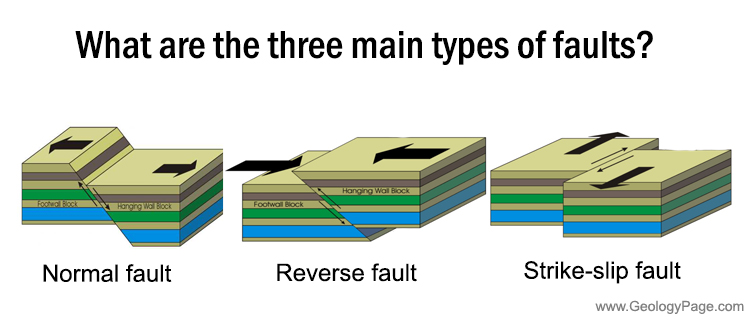
- It has two main types: dip-slip and strike-slip.
- Dip-slip Fault: when blocks of rocks fall along the angle of the crack (also known as the dip)
- It is composed of two blocks of rocks: the footwall block and the hanging wall block.
- The footwall block is the block below the crack.
- The hanging wall block is the block above the crack.
- It also has two types:
- Normal fault: when the hanging wall drops downward relative to the footwall.
- Reverse fault: when the hanging wall moves upward relative to the footwall.
- It is composed of two blocks of rocks: the footwall block and the hanging wall block.
- Strike-slip: when blocks of rocks neither drops or move upward, but slide past one another.
- Dip-slip Fault: when blocks of rocks fall along the angle of the crack (also known as the dip)
Elastic Rebound Theory
- It is the mechanism at which why earthquakes form.
- When a force or stress is applied in a system, it gains potential energy.
- But when the stress is removed, the energy is released and it propagates like a wave through a medium
- This process is known as rebound.
- In a fault line, when the rock cannot handle the stress, the fault slips and the stress is removed.
- The energy will then propagate like a wave in all directions and in through the rocks as a seismic wave.
- When this energy reaches the surface, it makes the ground shake, which forms the earthquake.
Aftershocks
- These are earthquakes formed after a previous earthquake.
Volcanoes
Volcano
- It is a geographical feature that is a rupture in the Earth’s crust that allows hot lava, volcanic ash and gasses to escape to its surface.
- Its name came from the god of fire in Roman Mythology, Vulcan.
Volcanic Eruption
- It is a geological phenomena when enough magma accumulates inside the volcano that it causes itself to release gas, rock fragments, lava flows, mudslides in its opening.
- It has two types: explosive and non-explosive/effusive.
- Explosive eruptions release and eject volcanic materials into the air.
- Effusive (non-explosive) eruptions let volcanic materials steadily flow on the surface of the volcano.
Parts of a Volcano
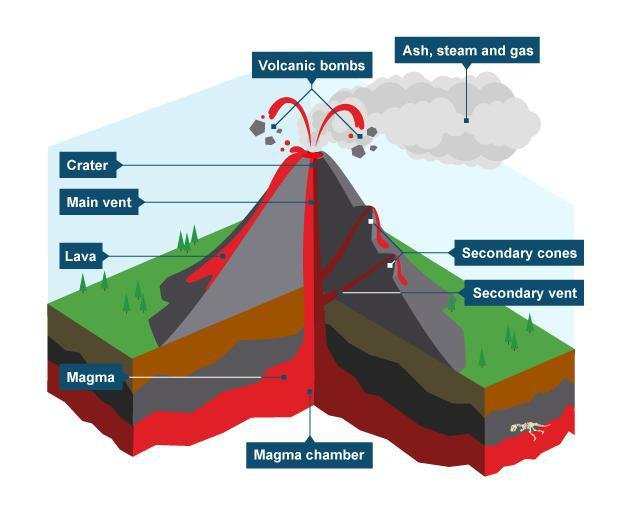
- Crater: an oval depression surrounding the main volcanic vent.
- Throat: the main passageway that connects the magma chamber to the surface of a volcano.
- Vent: an opening in the volcano from which volcanic materials escape.
- Conduit: an underground network of pipes where magma passes through
- Sills: an underground rock formation of solidified magma that forms when magma tries to fill in horizontal gaps in layers between rocks as it rises on the surface.
- Dikes: forms in the same way as sills but instead of between rock layers, it forms when there are cracks in the Earth’s crust, giving a more vertical and angled appearance.
- Parasitic Vent: also known as a secondary vent; alternate pathways other than the main vent that connects the magma chamber or the throat to the surface of the volcano.
- Parasitic Cone: a small, cone-shaped protrusion on the side of a volcano that formed due to accumulation of debris and ash coming off a parasitic vent that is surrounding it.
- Magma Chamber: it is a section underneath a volcano where magma is stored.
Types of Volcanic Material
- There are three types of volcanic material
- Lava: magma that comes from the mantle when it reaches the Earth’s surface.
- Tephra/Pyroclasts: any solid or semi-solid material that is ejected by a volcano
- This includes ash, lapilli, or volcanic bombs.
- Gas: may be composed of water vapor, carbon dioxide, sulfur dioxide and some impurities.
Type of Volcanoes
- Volcanoes can be classified according to volcanic activity or structure and magma composition.
- According to volcanic activity, volcanoes can be classified as:
- Active: has erupted lately; is most likely to erupt soon.
- Dormant: has not erupted for a long time but it has a chance to possibly erupt again.
- Extinct: had erupted before but it does not have a chance to erupt again.
- According to structure, they can be classified as:
- Composite: has a more steeper slope; ejects high viscosity lava; composed of hardened layers of lava and tephra.
- Cinder Cone: the simplest type of volcano; composed of loose pyroclastic fragments; less steeper than composite volcanoes
- Shield: ejects less viscous lava; it has a shield-like appearance with a gently steep slope.
- Caldera/Crater: forms when a volcano expels vast amounts of magma that it collapses into itself, forming a depression on the surface, known as a caldera.
- According to volcanic activity, volcanoes can be classified as:
Landslides
Landslide
- It is any form of rapid mass movement or earth down a slope.
- There are 4 main causes of landslides:
- a less cohesive, more loose layer of soil atop a steep slope becomes fluid
- when soil atop a steep slope is saturated with water, either during heavy rainfall or snowmelt, or in areas near rivers and lakes
- when a mass of soil is disturbed during an earthquake, causing it to fall down
- due to human activities, such as deforestation, blasting, construction, or logging.
- trees hold soil via their roots and absorb water well, one factor in landslides.