Objectives
- Define the algebraic limit laws
- Use the limit laws to evaluate the limit of a polynomial function.
- Use the limit laws to evaluate the limit of a rational function.
- Use the limit laws to evaluate the limit of a radical function.
Algebraic Limit Laws
- Before, we have been using tables and graphs to approximate the true value of a limit of a function.
- However, some of these functions can be broken down into its individual parts, which we can then use to compute the limit.
- But before we do that, we first introduce the two most basic limit laws: the constant and identity limit laws.
Definition
Basic Limit LawsLet
be any real number constant.
- The first rule makes sense since if the function is a constant, then regardless of the value we are approaching, the limit is equal to the constant itself.
- The second rule also makes sense.
- As we approach the function
at any point , the value of the limit eventually approach the value we want to approach.
- As we approach the function
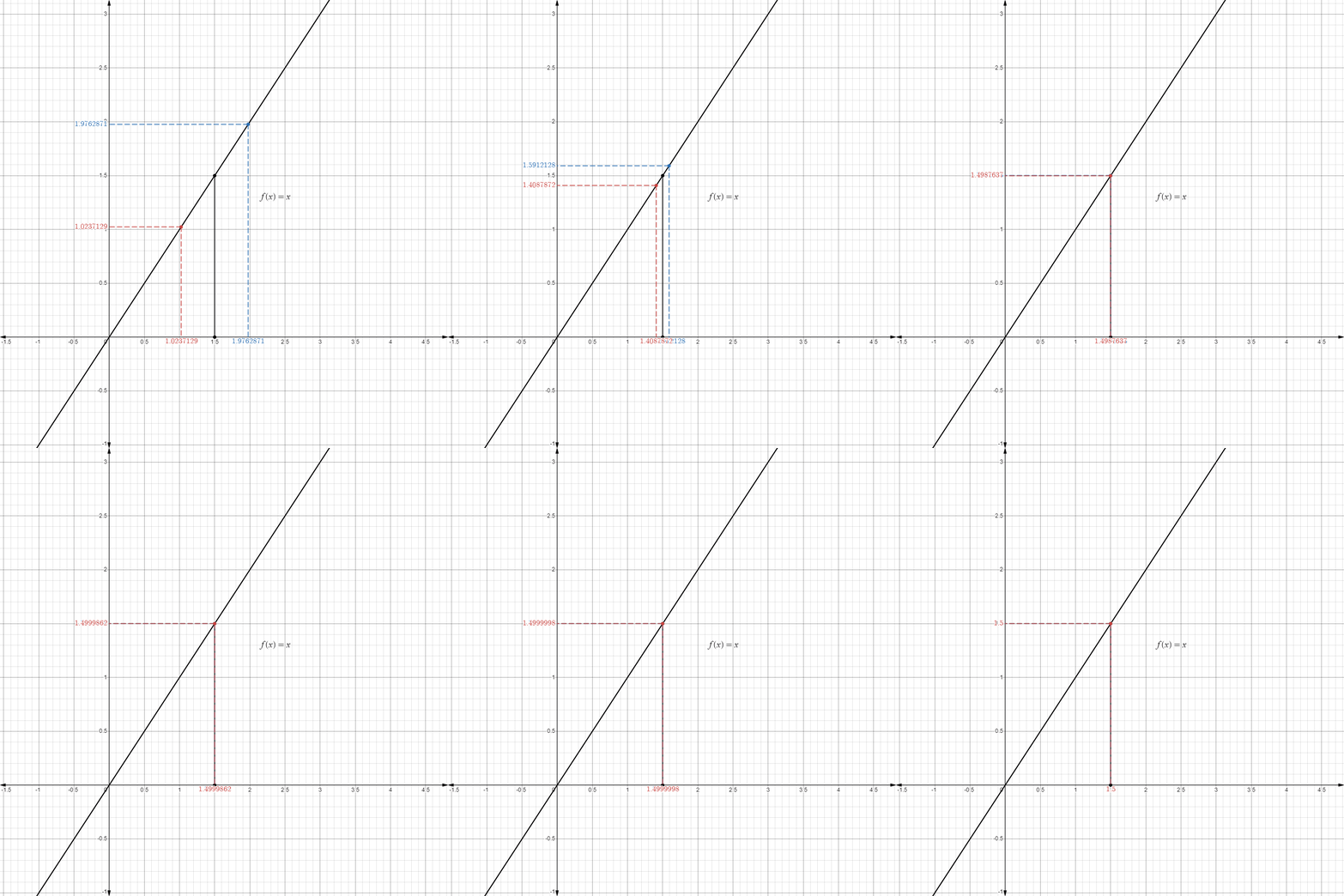
- Now that we have established this, we now introduce the algebraic limit laws
Definition
Algebraic Limit LawsLet
and be functions and be constants. If there exist finite, real numbers and , where: then these following rules should apply.
- To practice working with these rules, let us work on the following limit below:
- First, we can use the difference rule to express the statement into two separate limits.
- The limit
can be broken down further using the constant multiple rule.
- We have now broken our limit enough that we can now use the basic limit laws to evaluate them.
- Therefore:
Evaluating Limits of Polynomial Functions
- When we evaluate the limit of a polynomial function, we use the sum, difference and power rules to simplify the limit even further.
- The goal is to break the limit of a polynomial function into multiple limits that can be evaluated using the basic limit laws.
Worked Example 1
Evaluating the Limit of a Quadratic FunctionEvaluate
. Solution
Therefore,
.
Worked Example 2
Evaluating the Limit of a Cubic FunctionEvaluate
. Solution
Therefore,
Evaluating Limits of Rational Functions
- Similar to how polynomial functions can be broken into smaller limits the same goes for rational functions.
- We first use the quotient rule break the limit of a rational function into the limit of the numerator over the limit of the denominator.
- Then, we use the sum, difference, constant multiple, and power limit laws to break the numerator and denominator into simpler limits.
Worked Example 3
Evaluating the Limit of a Rational FunctionEvaluate
. Solution
Therefore,
.
- One important caveat here is that the limit of the denominator must not equal to
. - This could indicate a division by zero.
- Therefore, if that is the case, then the limit of the rational function does not exist.
Worked Example 4
Evaluating the Limit of a Rational Function that Doesn't ExistEvaluate
. Solution
Therefore, the limit
does not exist.
Evaluating Limits of Radical Functions
- Suppose that we have the limit below.
- By knowing that
is the same as , we can then use the power rule.
- Therefore, as an extension to the Power Law, we now introduce the Root Law.
Definition
Root Law of LimitsLet
and be a constant where and . Given that where is some finite, real number, then these rules apply.
- If
is odd, then:
- If
is even, then: If
is even and the limit of is less than , then the limit does not exist.