Objectives
- Explain the concept of a function and a piecewise-defined function.
- Evaluate a function at a point.
- Perform basic algebraic manipulation of functions.
- Perform a composition of two functions.
- Differentiate between different types of relations.
- Use graphical tests to determine the type of relation of a graph.
What is a Function?
- Informally, a function is something that takes in a value, and spits out an another value.
- For instance, suppose that we have the function
.
- If we input the number
in our machine, then the function will output . - Therefore:
- In general, we can input any number into our function and it will give us a single output value.
- For instance, here is the function
on different inputs of .
- For instance, here is the function
The Formal Definition of a Function
- A relation is defined as any set of ordered pairs.
- A function is a relation with no two distinct ordered pairs in a set has the same
-coordinate. - For instance, the set of ordered pairs
listed below is a function.
-
The set
is a function because neither two or more ordered pairs in the set does not have the same -coordinate. - However, the set
is not a function as both the ordered pairs and has the same -coordinate.
- However, the set
-
The domain of a function is the set of all input values, or
-coordinates of all of the ordered pairs in the set. - For example, the domain of set
is:
- For example, the domain of set
-
The range of a function, is the set of all output values, or
-coordinates of all of the ordered pairs in the set. - For example, the range of set
is:
- For example, the range of set
Definition
FunctionA function is a relation defined as the set of ordered pairs
where no two distinct ordered pairs has the same -coordinate. The domain of a function is the set of all input values
, while the range of a function is the set of all output values .
Function Notation
- In mathematical terms, we use the notation
to represent a function. - Verbally, we pronounce
as ” of ” - In this notation, we use
as the input variable for the function.
- Verbally, we pronounce
- We can also use any small or capital letter in the English and Greek alphabet to refer to a different function.
- For instance, we can call a function as:
is pronounced as “capital of ” or simply ” of ”
is pronounced as ” of ”
is pronounced as “alpha of ”
- For instance, we can call a function as:
- We can also use a different variable as the input variable of a function.
- For example,
is pronounced as ” of ” - Keep in mind that if we intend on notating functions this way, it should be consistent with the input variables that we use if we represent it as an equation.
- For example,
Representations of Functions
- A function can be represented in a variety of ways.
- First of all, you can write functions via its definition: as a list of elements in a set of ordered pairs.
-
Next, functions can also be represented as a mapping of values from the domain to the range.
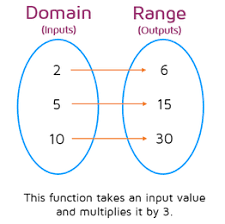
-
If the set of ordered pairs has a direct mathematical relationship between the
and -coordinates, then we can represent it as an equation. - If a function is expressed this way, then it is a solution to the equation
.
- If a function is expressed this way, then it is a solution to the equation
- Functions can also be represented as a table of values.
- If we consider all possible ordered pairs of a function defined as an expression, we can make a graph of the function
- A graph is a graphical collection of all possible ordered pairs that satisfy the equation
. - Here, we plot the inputs,
, over the -axis, and the output values. , on the -axis. - For example, if we plot the table of values below for
, we get:
- A graph is a graphical collection of all possible ordered pairs that satisfy the equation
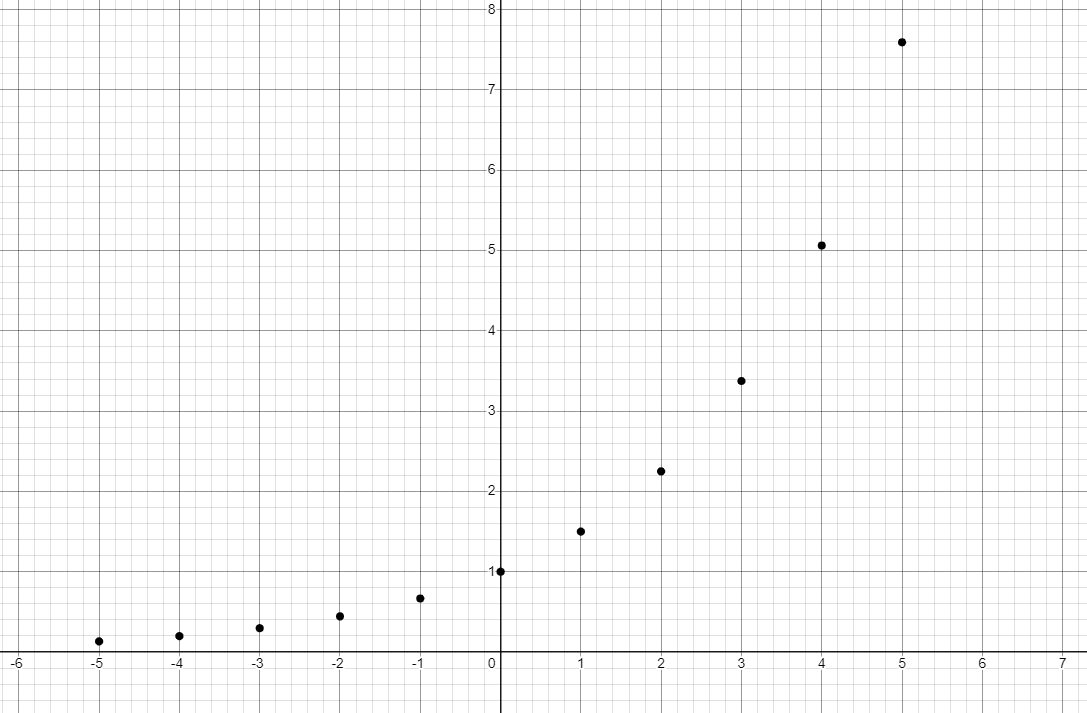
- If we plot the remaining points for all real numbers, we get the graph of
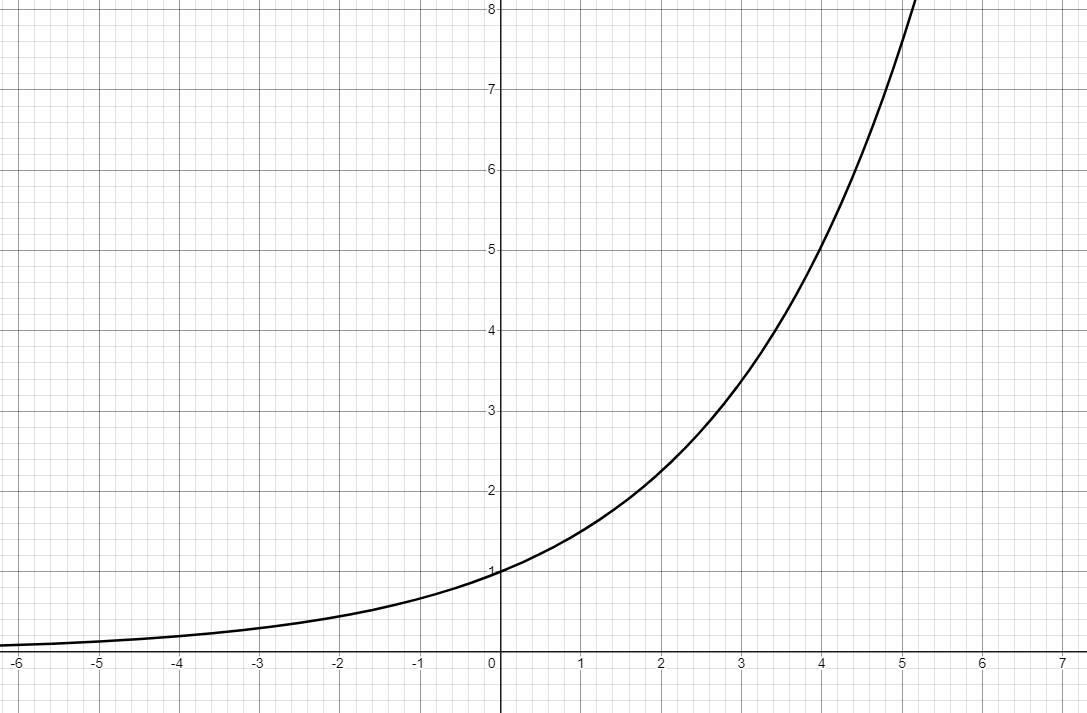
Evaluating Functions
- Evaluating a function means inputting something inside a function.
- In our previous example, inputting
into the function means replacing the input variable with , then simplifying the resulting expression.
- We can also use variables or expressions as inputs as well.
- For example, we can evaluate
when .
- For example, we can evaluate
Worked Example
Evaluating FunctionsLet
.
Evaluatewhen:
Solution
- For
, we simply substitute in with .
- For
, we simply substitute in with .
- For
, we substitute in with .
- For
, we substitute in with
- An other type of function is a piecewise function.
- A piecewise function may be composed of two or more smaller functions that apply only to different sections of the domain.
- For instance, consider the function:
- The above function says that:
- If
is greater than or equal to , then we use the expression to evaluate . - While if
is less than 2, then we use the expression to evaluate instead.
- If
- As an another example, consider the following function:
- The function
says that: - If
is an even number, then we use the expression to evaluate . - While if
is an odd number, then we use the expression to evaluate .
- If
Definition
Piecewise FunctionA piecewise function is a function which is composed of two or more smaller functions
which then apply to different sections of the domain. Each condition may be represented as an inequality to represent a subset of numbers in the real number line.
If the inputsatisfies that condition, then the value of the function at is the expression associated to that condition evaluated at . Note that if a piecewise-defined equation has a single input value that satisfies two or more conditions, then the equation is not a function.
- We can use the worked example below as practice.
Worked Example
Evaluating Piecewise FunctionsThe function
is defined as the piecewise function Find
if:
Solution
- When
, the input satisfies the first condition , therefore we use the function in orange .
- When
, the input satisfies the second condition , therefore we use the function in magenta .
- When
, the input satisfies the first condition , therefore we use the function in magenta .
- When
, the input satisfies the first condition , therefore we use the function in orange .
- When
, the input satisfies the first condition , therefore we use the function in orange .
Operations on Functions
- We can make new functions by combining two or more existing functions.
- This can be done through basic algebraic operations on two or more functions.
- It includes addition, subtraction, multiplication, division or any number of combinations of these operations.
Definition
Algebraic Operations on FunctionsGiven two functions,
and , the algebraic operations for two functions is defined as:
- Using this, we can evaluate expressions involving two different functions.
Worked Example
Simplifying Expressions involving Algebraic Combinations of FunctionsLet
and .
Perform the following operations involving functions:
Solution
For
: For
: For
, you can either use FOIL method or distribute the binomial to each term to multiply the binomial. For
:
Worked Example
Evaluating Algebraic Combinations of FunctionsLet
and .
Evaluate:
Solution
Simply apply the definition for algebraic operations of functions from before.
For: For
: For
: For
:
Composition of Functions
- A composition of two functions is when we evaluate a function inside an another function.
- In other words, we are taking a function as an input to an another function.
- We can then express the input
as:
- We express a composition of two functions
and using the symbol .
- One property of a function composition is it is not commutative.
- This means that it is not always the same function when the order of functions in composition are reversed.
- In short:
- To demonstrate the property above, we can use the machine analogy from before.
Letand .
Definition
Composition of FunctionsGiven two functions
and , if is the input of , then we call the entire operation as the composition of functions. The resulting function is called a composite function where we write as: A composition of two functions is noncommutative, which means that in some cases the property below applies.
Worked Example
Evaluating Composite FunctionsLet
and .
Evaluate the following:
Solution
For
, we first evaluate the inside expression . For
, we first evaluate the inside expression .
Toolkit Functions
- Some of the most common functions are formed from algebraic combinations and compositions of toolkit functions.
- These are the base form of the common functions we often see in Algebra
- Included below are the most common functions and their domains and ranges.
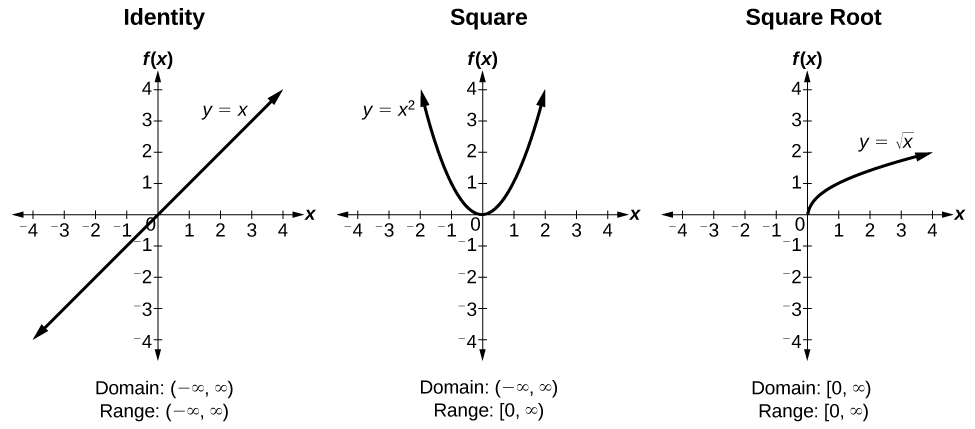
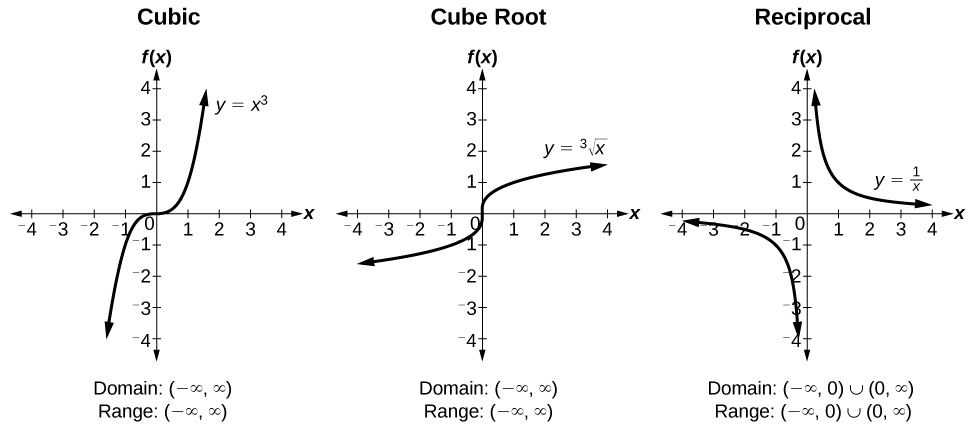

Note
- The identity function is also called the linear function.
- The square function is also called the quadratic function.
- The reciprocal function is also called the rational function
Function Relations
-
Relations can be classified by the type of relationship each ordered pair has between its
and -coordinates - They can be classified as either one-to-one, many-to-one, or one-to-many.
-
A one-to-one relation happens when exactly one item in the input pairs with exactly one item in the output where no two inputs has the same output.

-
A many-to-one relation happens when at least two or more distinct inputs pair to the same item in the output.
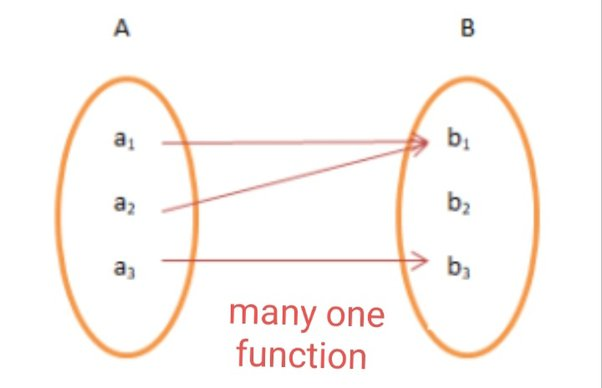
-
A one-to-many relation happens when at least one input pairs to two or more distinct items in the output.
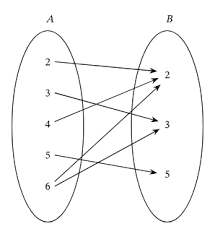
-
As we can see, a one-to-many relation is not a function as one item in the input
pairs to both and . - However, a one-to-one or a many-to-one relation is a function as one item in the input only pair to only one item in the output regardless of whether two inputs pair to the same output or not.
Vertical Line Test
- Some graphical tests can be performed to determine the type of relation a graph of an equation has.
- The vertical line test is a test that allows you to determine if the graph of an equation is a function or not.
- This tells us that if a vertical line hits the graph at two or more distinct points, then the graph of an equation is not a function
- To show this, consider the graph of
.
- Since the vertical line only hits at a single point anywhere in the graph, then
is a function. - Now take a look at the graph of the equation
. - Since the graph hits at two distinct points, then the graph of this equation is not a function
Vertical Line Test for Piecewise-defined Equations
- Some piecewise-defined equations may not be functions as well.
- Consider this equation defined as:
- Graphing this equation shows us:
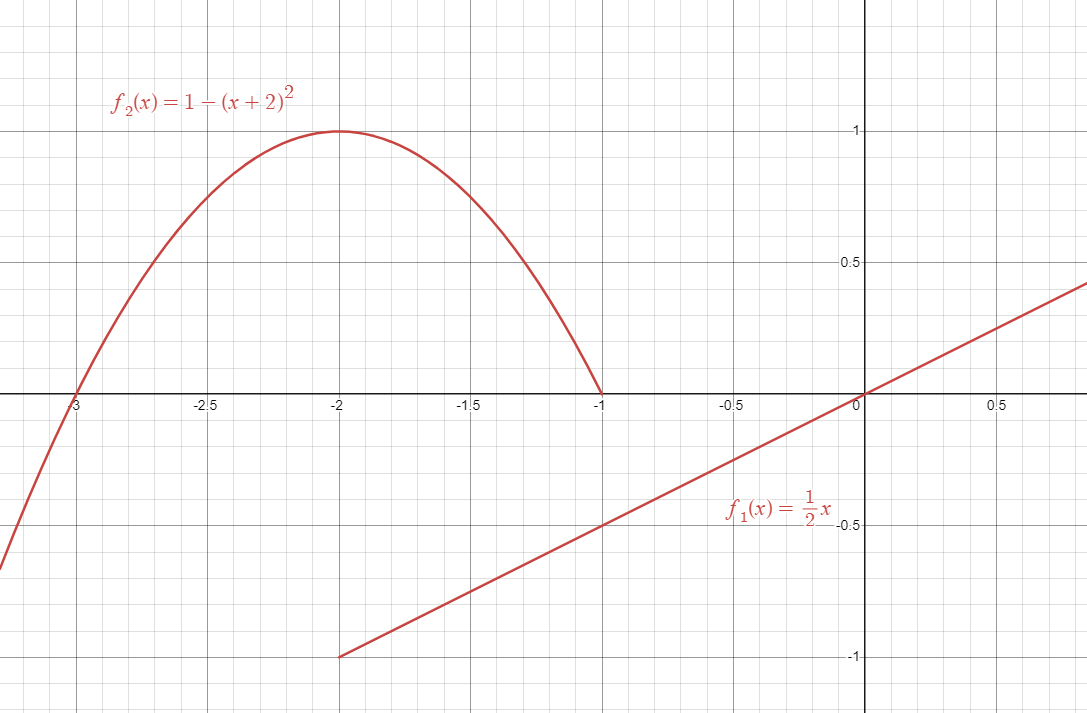
- As we can see, there is a set of inputs
where the output has two distinct values. 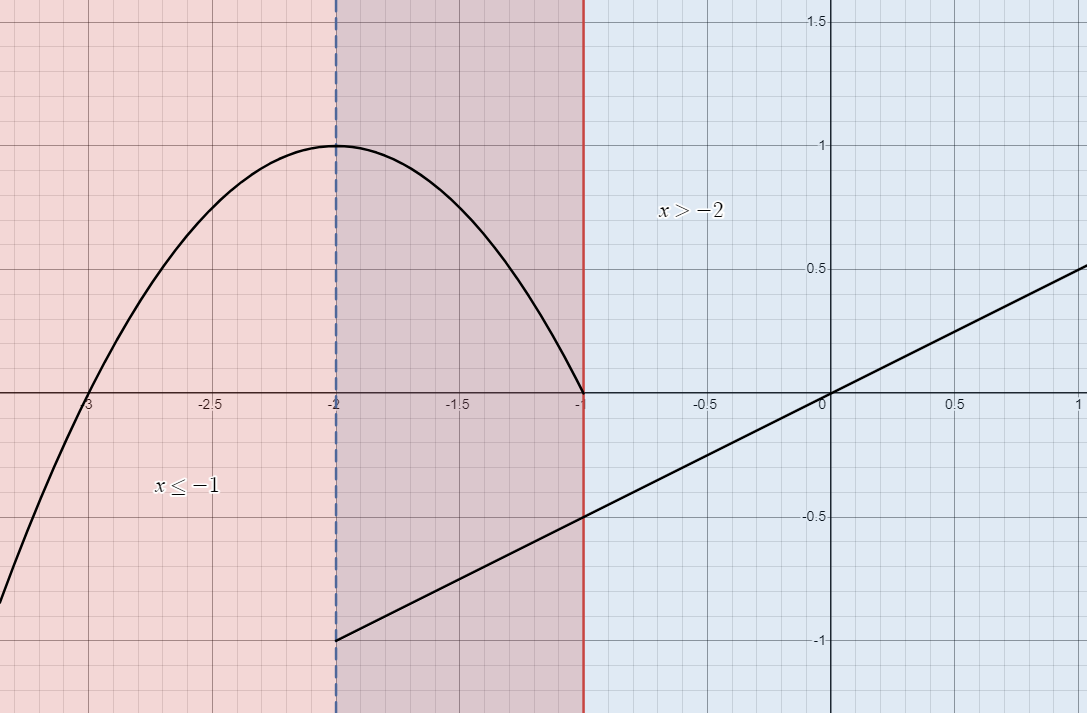
- From the vertical line test, it is obvious as well that this piecewise-defined equation is not a function.
- Consider this piecewise-defined equation next:
- Graphing this equation shows us that:
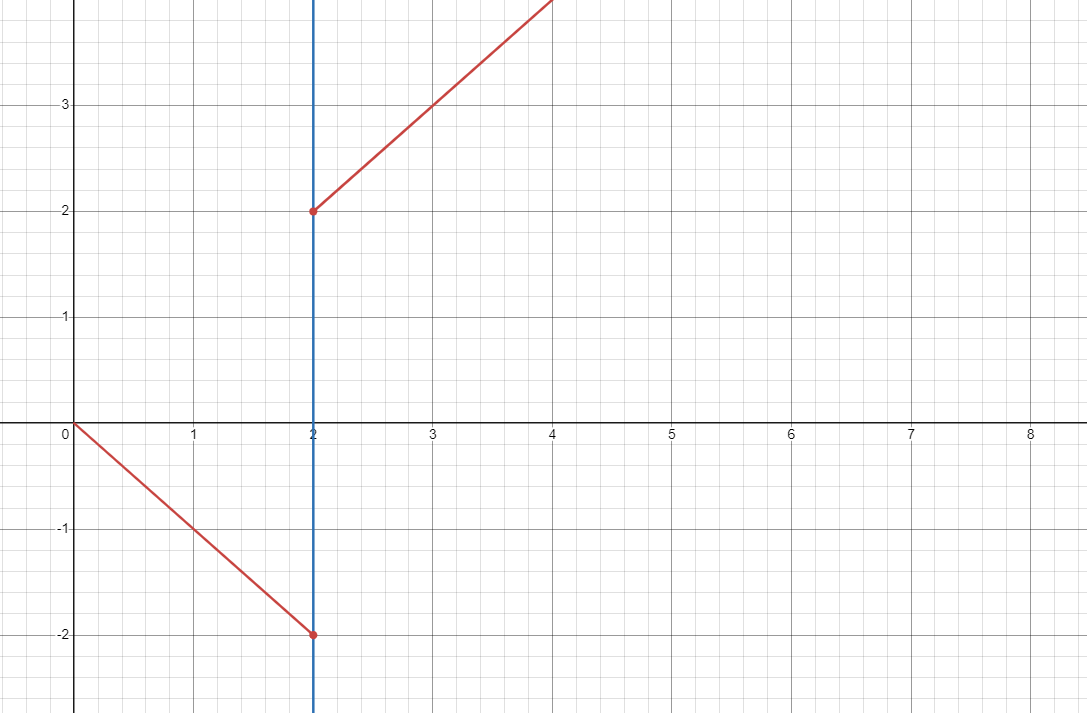
- This indicates that a vertical line passes through two distinct points: at
and at . - Therefore, this piecewise-defined equation is not a function.
- However, if we were to change one of the conditions as:
- Then, the vertical line at
will not pass at anymore because the expression is no longer defined on that interval. 
- Therefore, the equation from above is a function.
Horizontal Line Test
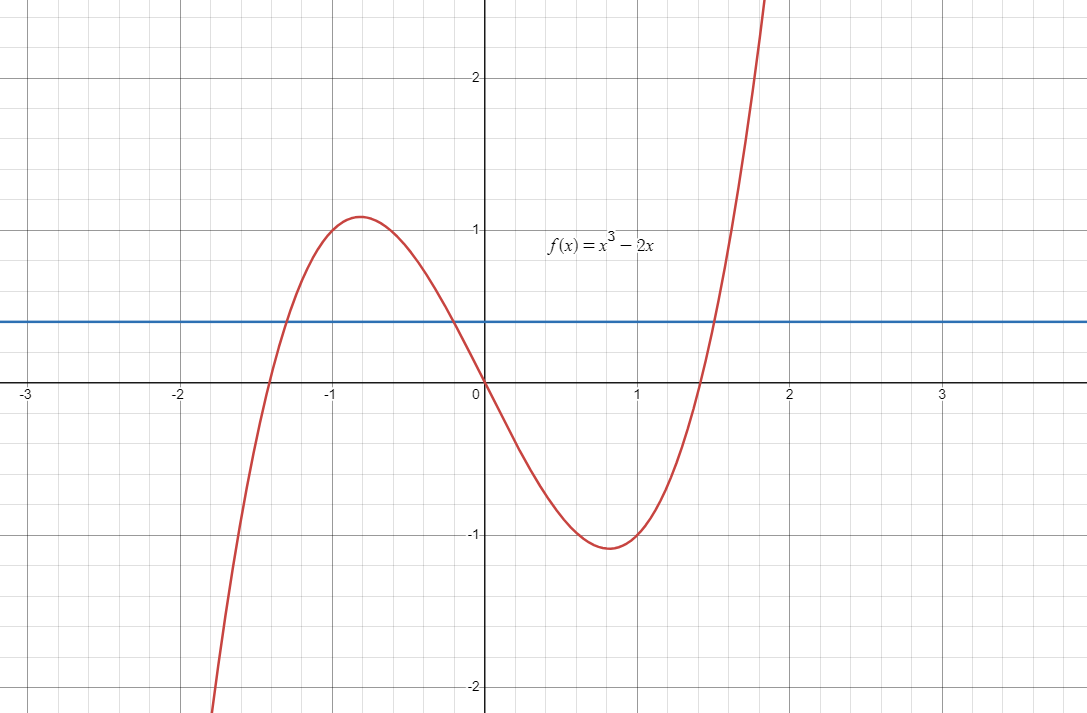
- The horizontal line test determines if a function
is one-to-one or not. - This can allow us to determine which functions is invertible.
Functions that are invertible has a one-to-one inverse function.
- This can allow us to determine which functions is invertible.
- Consider the function
. - The graph of this function shows that a horizontal line intersects at three distinct points.
- This means that this function is not a one-to-one function.
- On the other hand, consider the function
. - The horizontal line intersects at a single point anywhere in the graph, therefore it is a one-to-one function.
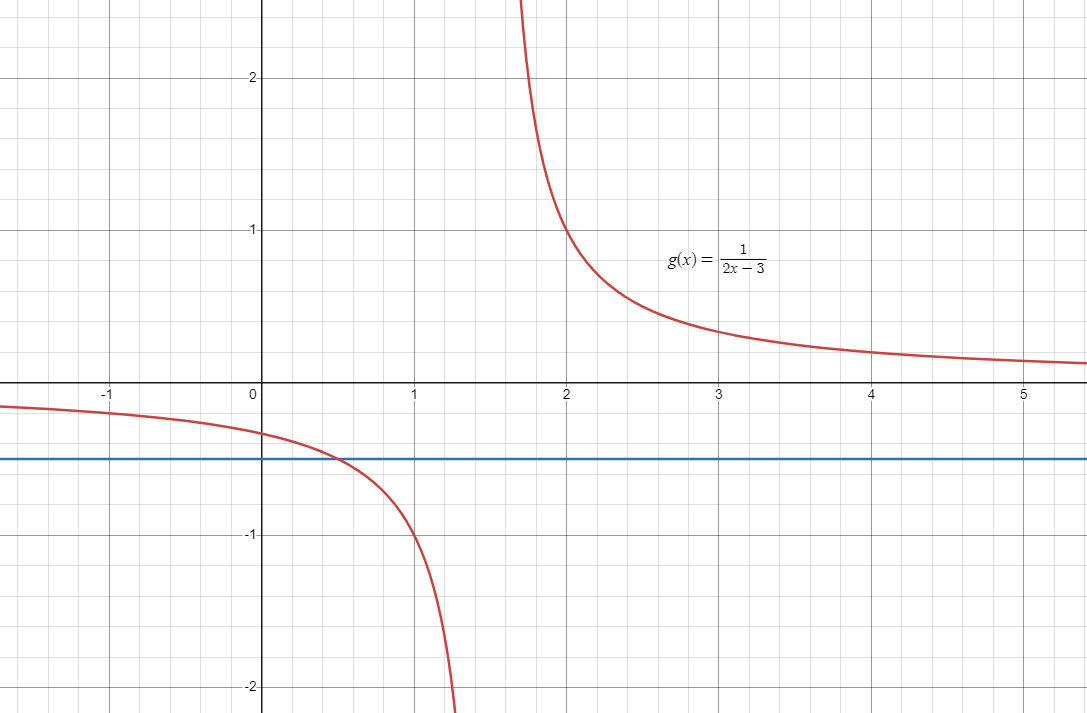
- The horizontal line intersects at a single point anywhere in the graph, therefore it is a one-to-one function.
Further Study
- [Algebra and Trigonometry 2e: Functions and Function Notation]( https://openstax.org/books/algebra-and-trigonometry-2e/pages/3-1-functions-and-function-notation|Algebra and Trigonometry 2e: Functions and Function Notation)
- Algebra and Trigonometry 2e: Domain and Range
- Algebra and Trigonometry 2e: Composition of Functions