Work in Progress!
This note is under construction!
Some sections of this note may still be broken or left incorrectly rendered.
Properties of Waves
- Waves have two main physical properties: amplitude and wavelength
- The amplitude is the distance from the equilibrium line (the center line) to the crest or to the trough
- The wavelength is the distance between two crest or two trough.
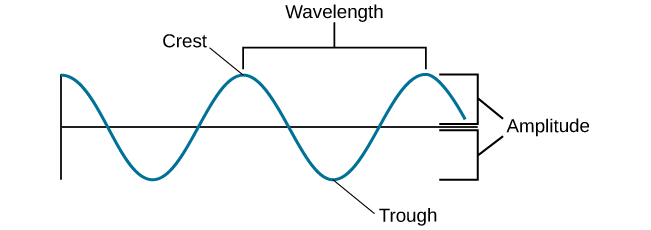
- The frequency of a wave is the number of waves that pass a given period.
- It is often expressed in Hertz
or cycles per second - It is also directly related to the wavelength of a wave.
- Longer wavelengths
lower frequencies
Shorter wavelengthshigher frequencies
- Longer wavelengths
- It is often expressed in Hertz
Light Waves
- The electromagnetic spectrum encompasses all of electromagnetic radiation that occurs in our environment.
- The visible light spectrum is the only portion of the electromagnetic spectrum that we can see
- Waves within this spectrum has wavelengths that range from
.
- Waves within this spectrum has wavelengths that range from

- Other species can detect other portions of the electromagnetic spectrum.
Color Perception
- Our perception of color is dependent on the wavelength of light
- Longer wavelengths of light are associated with warmer colors: red, orange, yellow
- Shorter wavelengths of light are associated with cooler colors: green, blue, violet

Sound Waves
-
We perceive the frequency of a sound wave as its pitch.
- A high-frequency wave means a high-pitched sound and a low-frequency wave means a low-pitched sound.
-
Humans can hear between
. - We can easily pick up sounds with frequencies that fall in the middle of this range.
- Other species can differ in their audible range.
-
We perceive the amplitude of a soundwave as its loudness.
- A high amplitude sound wave means a louder sound.
-
Loudness is measured in terms of decibels (
)