The Cells in the Nervous System
-
composed of two basic cell types:
- glial cells
- provides “scaffolding” on which the nervous system is built
- allows neuronal communication by helping them line up closely with each other.
- provide insulation to neurons
- transport nutrients and waste products
- mediate immune responses
- neurons
- serves as interconnected information processors
- the central building blocks of the nervous system
- essential for all the tasks of the nervous system
- glial cells
-
It is also said that there may be a nearly
ratio of glial cells to neurons - This suggests that human brains are more similar to primate brains than previously though
Neuron Structure
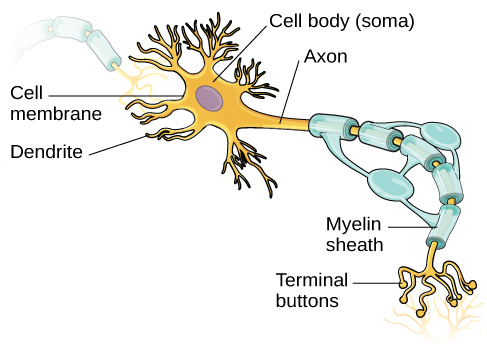
-
The neuron’s outer surface is made up of a semipermeable membrane
- it allows smaller molecules and molecules without an electrical charge to pass through
- it also stops larger or highly charged molecules.
-
The nucleus of the neuron is located in the soma, or the cell body.
-
The soma has branching extensions known as the dendrites
- These serves as input sites received from other neurons
-
Input signals are transmitted electrically across the soma and down a major extension known as the axon.
- The axon ends with multiple terminal buttons.
- Each terminal button contains a synaptic vesicle.
- The synaptic vesicles house neurotransmitters, which is then used to transmit signals to other neurons.
-
Axons may range from a fraction of an inch to several feet.
-
Some axons are coated by a fatty substance known as the myelin sheath
- It is also created by the glial cells
- It serves as an insulator and it increases the speed the signal travels
- This is why it is crucial for normal operation and the loss of insulation can be detrimental for normal function
- The myelin sheath is has gaps and is not continuous.
- The gaps are known as the Nodes of Ranvier
-
As the neuronal signal moves rapidly down the axon to the terminal buttons, the synaptic vesicles release neurotransmitters into the synaptic cleft.
- The synaptic cleft is the space between two neurons.
- It also serves as an important site for communication.
-
Neurotransmitters would then bind to their corresponding receptors on the adjacent neuron
- Receptors are proteins on the cell surface where neurotransmitters attach.
- Specific neurotransmitters only bind to a specific receptors, similar to how a key fits into a lock.
Neuronal Communication
The process at which neurons communicate is an intricate process, so we divide each process for you to digest.
Properties of a Synapse
- The neuron exists in a fluid environment.
- It is surrounded by extracellular fluid.
- It also contains intracellular fluid (also known as cytoplasm)
- The neuronal membrane keeps these fluids separate.
- This is important as the neuronal signal depends on the intra- and extracellular fluids.
- The difference in charge between the two fluids, also known as the membrane potential, is what provides energy for the signal.
- The electrical charge of the fluids is caused by charged molecules dissolved in the fluid.
- The membrane itself restricts movement of these charged particles due to its semipermeable nature.
- Therefore, charged particles tend to be concentrated either inside or outside of the cell.
The Resting Potential
- Between signals, the neuron membrane undergoes a state called resting potential.
- During this point, ions line up on either side of the cell membrane.
- This is to prepare them to rush across the membrane once the neuron goes active, and the membrane opens its pores, or gates.
- Once it does, ions in highly concentrated areas move to less concentrated areas, while positive ions move to areas with a negative charge.
- In this resting state, sodium ions
are concentrated outside the cell, so it tends to move inside the cell. - Potassium ions
are more concentrated inside the cell, so it tends to move outside the cell. - A sodium-potassium pump maintains the level of charge inside the cell.
- The pump maintains the inside of the cell slightly negative than the outside of the cell by actively pumping in-and-out
and ions
- The pump maintains the inside of the cell slightly negative than the outside of the cell by actively pumping in-and-out
- In this resting state, sodium ions
The Action Potential
-
When the neuron receives a electric signal on its dendrites from an adjacent neuron:
- the signal goes from the dendrites of each synapse and the soma to the axon hillock (the boundary between the soma and the axon), where each signal gets combined.
- if the combined charge of this signal reaches a certain level called the threshold of excitation, the neuron becomes active and an action potential is triggered.
- any
ions that enter the cell may diffuse and provide additional charge to the signal, which may also trigger an action potential
- any
-
When action potential begins:
- sodium gates in the membrane open. creating an influx of
ions. - because of this, it creates a huge positive spike in the membrane potential.
- as positive ions rush into the cell, its internal charge becomes more positive.
- this is called the peak action potential.
- at peak action potential, sodium gates close and potassium gates open.
- as
ions leave, the cell quickly begins repolarization - it would hyperpolarize, becoming slightly negative than the resting potential.
- sodium-potassium pumps helps stabilize the membrane potential back into its resting phase
- sodium gates in the membrane open. creating an influx of
-
Once the action potential arrives at the terminal button, it releases neurotransmitters into the synaptic cleft.
All-or-None Property of Action Potential
- The action potential is an all-or-none phenomenon.
- This means that once a signal is sent, it cannot be stopped.
- This also indicates that an incoming signal may be or may not be sufficient to reach the threshold of excitation.
- This property allows our brain to feel sensations in any part of the body, no matter how distant it is. (Injury in your toe is as equally painful as injury in your nose)
Reuptake
- Once the signal is delivered onto an adjacent neuron, the neuron undergoes reuptake
- This process breaks down excess neurotransmitters into inactive fragments, then it gets reabsorbed back into the neuron that released it.
- This clears the synapse, and provides an “on” and “off” state between signals.
- This also helps regulate production of neurotransmitters so that no additional neurotransmitters need to be produced.
Types of Neuronal Communications
-
Communication between neurons is what’s called an electrochemical event.
- The movement of the action potential down the axon is an electrical event.
- The movement of the neurotransmitter across the synapse is a chemical event.
-
Some connections between neurons are entirely electrical.
- This connection is what’s called an electric synapse.
- This way, they physically communicate via gap junctions, which allows the current to pass from one neuron to the next.
- While these connections are scarce, they are much faster than chemical synapses (one that uses neurotransmitters).
Neurotransmitters and Drugs
- Different neurons release different neurotransmitters.
- Psychologists often focus on their effects as imbalances on neurotransmitter systems are often associated with psychological disorders
- Because of this, psychotropic medications, drugs that treat psychiatric symptoms by restoring neurotransmitter balance, are used to help improve symptoms associated with these disorders
- Here’s a list of major neurotransmitters and their effects on behavior:
| Neurotransmitter | Involved in | Potential Effect on Behavior |
|---|---|---|
| Acetylcholine | Muscle action Memory | Increased arousal Enhanced cognition |
| Pain Pleasure | Decreased anxiety Decreased Tension | |
| Dopamine | Mood Sleep Learning | Increased pleasure Suppressed appetite |
| Brain function Sleep | Decreased anxiety Decreased tension | |
| Glutamate | Memory Learning | Increased learning Enhanced memory |
| Norephinephrine | Heart Intestines Alertness | Increased arousal Suppressed appetite |
| Serotonin | Mood Sleep | Modulated mood Suppressed appetite |
-
Psychoactive drugs can have different types depending on their function
- Agonists are chemicals that mimic a neurotransmitter at the receptor site. ^agonists
- Example: dopamine agonists are used to ease symptoms of Parkinson’s disease, which is caused by low levels of dopamine
- Antagonists are chemicals that blocks or impedes the normal activity of a neurotransmitter at the receptor. ^antagonists
- Example: dopamine antagonists are used to ease symptoms of schizophrenia associated with overactive dopamine transmission.
- Reuptake inhibitors prevent unused neurotransmitters from being transported back into the neuron, therefore increasing their effectiveness for longer durations ^reuptake-inhibitors
- Example: serotonin reuptake inhibitors are used to treat depression, which has been linked to reduced serotonin levels.
- Agonists are chemicals that mimic a neurotransmitter at the receptor site. ^agonists
-
Psychotropic drugs are not instant solutions to people suffering to psychological disorders.
- Often, psychotropic drugs take several weeks before seeing improvement.
- Some psychotropic drugs have significant negative side effects.
- Some individuals vary dramatically on how they respond to drugs
-
Therefore, drugs, along with other forms of therapy tend to be more effective than any one treatment alone.