Objectives
- Define what is a rock.
- Identify the three major types of rock and their characteristics
- Describe the rock cycle.
- Identify the exogenic processes responsible for turning rock into sediment.
What is a Rock?
- A rock is can either be a consolidated aggregate of:
- various types of minerals, or
- multiple, individual pieces, or grains, of the same kind of material.
- There are three main types of rock: igneous, sedimentary, metamorphic.
Igneous Rocks
Info
This entire section is also part of the lesson Metamorphism and Igneous Rocks.
Igneous Rocks
- Their name came from the Latin word ignis, meaning fire.
- These rocks are formed via volcanic activity.
- As magma cools and solidifies, it becomes an igneous rock.
Types
-
Extrusive
- They are also called volcanic rocks.
- It is molten material that solidifies at the Earth’s surface.
- These are made from lava.
- Some examples include:
- Basalt: dark-colored, fine-grained, has high specific gravity, hard.
- Obsidian: dark-colored, has glassy surface, has no crystals.
- Pumice: has many air holes.
- As gas bubbles get trapped during the cooling process, it leaves behind tiny pockets of air, hence many air holes.
- Scoria: formed similar to pumice, has larger holes, much denser and darker.
-
Intrusive
- They are also called plutonic rocks.
- They are molten material that solidifies beneath the Earth’s surface.
- This means that magma is turning into solid.
- Some examples include:
- Granite: common rock type, light-colored, course-grained, most important rock in the curst.
- Gabbro: dark-colored, often called black granite.
- The dark color is because of its composition.
- It is composed of higher iron and magnesium composition, and lower quartz content.
Properties
-
Igneous rocks exhibit two main properties: texture and mineral composition.
- Texture
- This property describes the overall appearance of the igneous rock
- It is based on the size, shape, and arrangement of interlocking crystals.
- The size of crystals is dependent on the rate of cooling.
- When magma cools slowly, it results in the formation of large crystals.
- When magma cools rapidly, it results in the formation of small crystals.
- The type of texture depends on the size of the crystals:
- Course-grained: crystals can be seen with bare eyes.
- Medium-grained: crystals can only be seen with a hand lens.
- Fine-grained: crystals can only be seen with a microscope.
- The texture can be further classified as:
- Aphantic: characterized by a fine crystal structure
- Phaneritic: characterized by a coarse crystal structure
- Porphyritic: characterized by the formation of large and small crystals
- Glassy: a non-ordered solid with no visible crystal formation
- Plutonic: formed from ejected solids
- Mineral Composition
- This property is based on the chemical composition of the magma that formed the rock.
- Based on the composition of magma, it can be described as:
- Felsic: light-colored, lightweight, rich in silicon and aluminum.
- Mafic: dark-colored, heavier, lower in silica, rich in heavy minerals like iron and magnesium.
- Intermediate: a transition between mafic and felsic, appears gray in color
- Ultramafic: characterized with a very dark color
- Texture
-
The table below summarizes the properties of different igneous rocks.
| Type | Formed from? | Formed where? | Cooling rate | Grain Size |
|---|---|---|---|---|
| Intrusive (volcanic) | magma | below the Earth’s crust | fast | fine-grained |
| Extrusive (plutonic) | lava | above the Earth’s crust | slow | coarse-grained |
Sedimentary Rocks
Sedimentary Rocks
- These rocks are formed from the accumulation of sediments.
- The process of its formation is as follows:
- Sediments are tiny fragments of rock that break off due to weathering or uplifting.
- The process at which they get fragmented is deposition
- They are then transported either by wind or running water.
- This process is called erosion.
- As sediments move, they eventually settle down and build up on the ground or in the seafloor.
- This process is called sedimentation
- Processes like compaction and cementation then compress sediments into a sedimentary rock
- Compaction is a process when sediments are squeezed, compressed or compacted.
- Cementation is the process when dissolved minerals go in the tiny spaces among the sediments.
- Sediments are tiny fragments of rock that break off due to weathering or uplifting.
Types
-
Sedimentary rocks can be classified into one of these three types: clastic, chemical, organic.
- Clastic: forms from mechanical weathering debris.
- Examples are: breccia, conglomerate, sandstone, siltstone, shale.
- Chemical: forms when dissolved materials precipitate from the solution.
- Examples are: iron ore, flint, dolomites, and some limestone.
- Organic: forms from accumulation of plants or animal debris.
- One example is coal.
- Clastic: forms from mechanical weathering debris.
-
Some common examples of sedimentary rock are:
- Conglomerate: made of pebbles and pieces of gravel cemented together.
- Sandstone: made of sand grains; composed mainly of mineral quartz. It has medium weight, appears shiny, and generally rough.
- Shale: made from layers of mud and chemicals mixed with fine sand, organic matter, iron oxide, and some other impurities
- Limestone: made up of mostly calcium carbonate, comes from dead organisms.
Metamorphic Rocks
Info
This section only is part of the lesson Metamorphism and Igneous Rocks.
Metamorphic Rocks
- It comes from pre-existing rocks.
- These rocks undergo changes in their properties once heat, pressure, or chemical changes is applied.
- The process of transformation of rocks is called metamorphism.
- Meta means change, and morphe means form.
Metamorphism
- It is a change that takes place within a body of rock due to differences in its environment.
- There are three factors that influence the process of metamorphism:
- Both heat and pressure physically change the structure of the crystals in the rock.
- The presence of a chemically active liquid may enhance the process of metamorphism.
Types
- Metamorphic rocks are classified according to their appearance and how they form
- They can be classified as: foliated or non-foliated
- Foliated
- These rocks has a layered or banded appearance.
- They are formed from within the Earth’s interior.
- Here, there is extremely high temperature with unequal pressure.
- Some examples are:
- Slate: derived from shale, a gray colored rock. It is also fine-grained.
- Serpentine: it comes from basalt
- Gneiss: it is derived from conglomerate
- Non-foliated
- They do not have a layered appearance.
- These rocks are formed around intrusive rocks.
- When these rocks are heated, minerals in the rock begin to recrystallize.
- As a result, their atoms reorganize, becoming more compact and dense.
- Some examples are:
- Marble: derived from limestone; it is a hard crystalline rock; considered as the most beautiful rock because of its luster.
- Quartzite: derived from sandstone; very hard and durable.
- Foliated
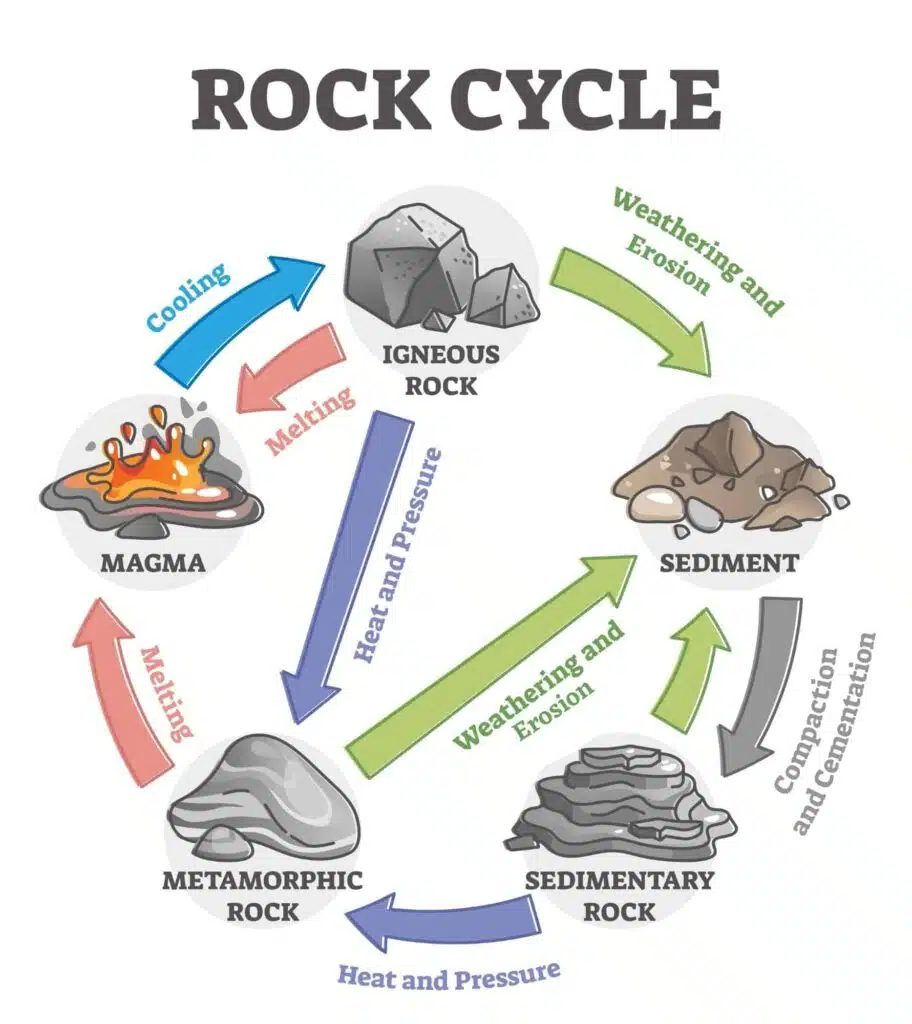
The Rock Cycle
- The rock cycle is a biogeochemical cycle that shows how rocks change and transform among the three rock types.
- It says that over a long period of time, rocks change and transform as they encounter new environments.

Exogenic Processes
- Exogenic Processes are processes that occur at or near the Earth’s surface.
- They are an essential part of the rock cycle.
- They are also responsible for turning rock into sediment.
- These exogenic process include: weathering, mass wasting, erosion, transportation, and deposition.
- Weathering
- It is the physical breakdown or the chemical alteration of rocks at or near the Earth’s surface.
- They can be classified into mechanical or chemical weathering.
- Mechanical weathering is when large rocks break into small fragments without changes in its physical composition.
- Nature has some physical properties that break rocks into smaller pieces.
- They include frost and some biological activity.
- Chemical weathering is when rocks decompose through chemical change.
- Some processes that may be involved are: oxidation, hydrolysis, carbonation and solution, and biological action.
- Mechanical weathering is when large rocks break into small fragments without changes in its physical composition.
- Erosion
- It is the process of transporting weathered sediments through any means.
- Sediments are removed from their original site by natural agents called agents of erosion.
- These agents include: running water, glacier, and wind.
- Mass Wasting
- It is the process of moving rocks, soil and regolith via gravity.
- They can have several types:
- Rock/Debris Fall: when a piece of rock or mass becomes dislodged and free-falls along a steep cliff.
- Landslide: a sudden fast movement of a cohesive mass or soil or rock.
- Flows: soil or rock mixed with water that flows along its path.
- Granular flows have 0-20% water.
- Slurry flows have 20-40% water.
- Transportation
- It is the process of how eroded material moves.
- They can be transported in four different ways.
- Solution: material is dissolved in water and is carried along as it moves.
- Suspension: material is suspended in a medium and is carried as it moves.
- Traction: Particles move by rolling, sliding, or shuffling along an eroded surface.
- Saltation: particles move from the surface to the medium in quick repeated cycles.
- Deposition
- This is a process where weathered sediments accumulate to create different landforms.
- Weathering