Info
Looking for the solution on the General Mathematics activity last September 09, 2024? Go here!
Objectives
- Define the domain and range of a function.
- Describe what is a rational function.
- Describe the features of the graph of a rational function: its asymptotes, zeros, and intercepts.
- Find the vertical and horizontal asymptotes of a rational function.
- Find the zeroes and intercepts of a rational function.
- Determine the domain and range of a rational function
- Graph rational functions.
Domain and Range
- Previously, we knew in Key Concepts of Functions that the domain is the set of all possible inputs of a function while the range is the set of all possible outputs of a function
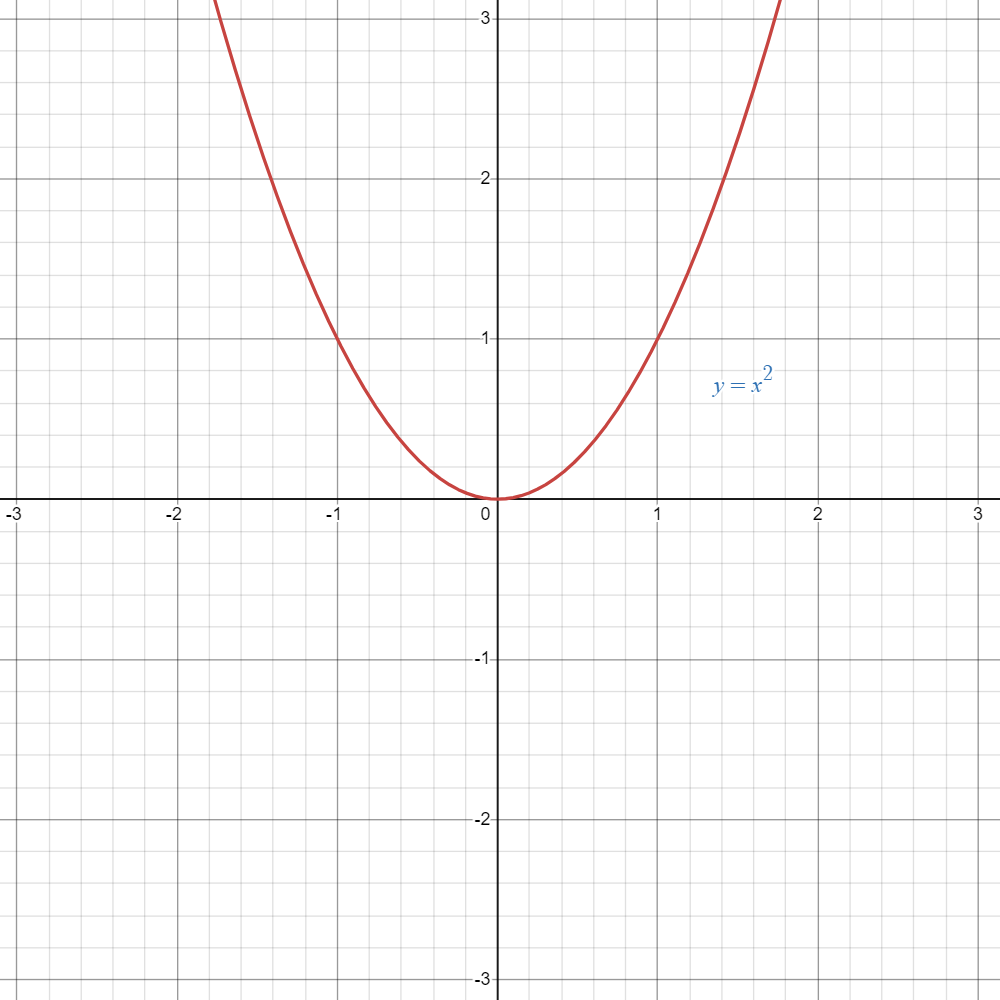
- But what does this exactly mean? Let’s study the function:
- We know that we can square any real number and it will give us a single result.
- Therefore, the domain is the set of all real numbers.- However, know for the fact that when we square a number, it will always return a positive value.
- Therefore, the list of possible outputs, the range, is all positive real numbers.
- We can see that this is true by looking at the graph of
. - The possible inputs along the
-axis may span indefinitely, but the possible outputs along the -axis does not go below .
- The possible inputs along the
Definition
Domain and RangeThe domain of a function
is the set of all acceptable input values where is defined. The range of a function
is the set of all possible outputs of , .
Worked Problem
Finding the Domain and Range of a Function from a Table of ValuesThe table below shows the possible inputs and their corresponding outputs for the function
. Find its domain and range. Solution
The domain is the set of the all possible inputs, therefore we look at the left side of our table and list all inputs for
: The range is the set of all possible outputs, therefore we look at their corresponding outputs at the right side of our table, and list them:
Set and Interval Notation
-
When we deal with domain and range, unlike functions defined as a table of values, some functions may have an with an infinite set of possible inputs and outputs.
-
This is where we introduce the concept of set notation and interval notation.
- We use these to indicate a range of values that might be included in a function’s domain or range.
-
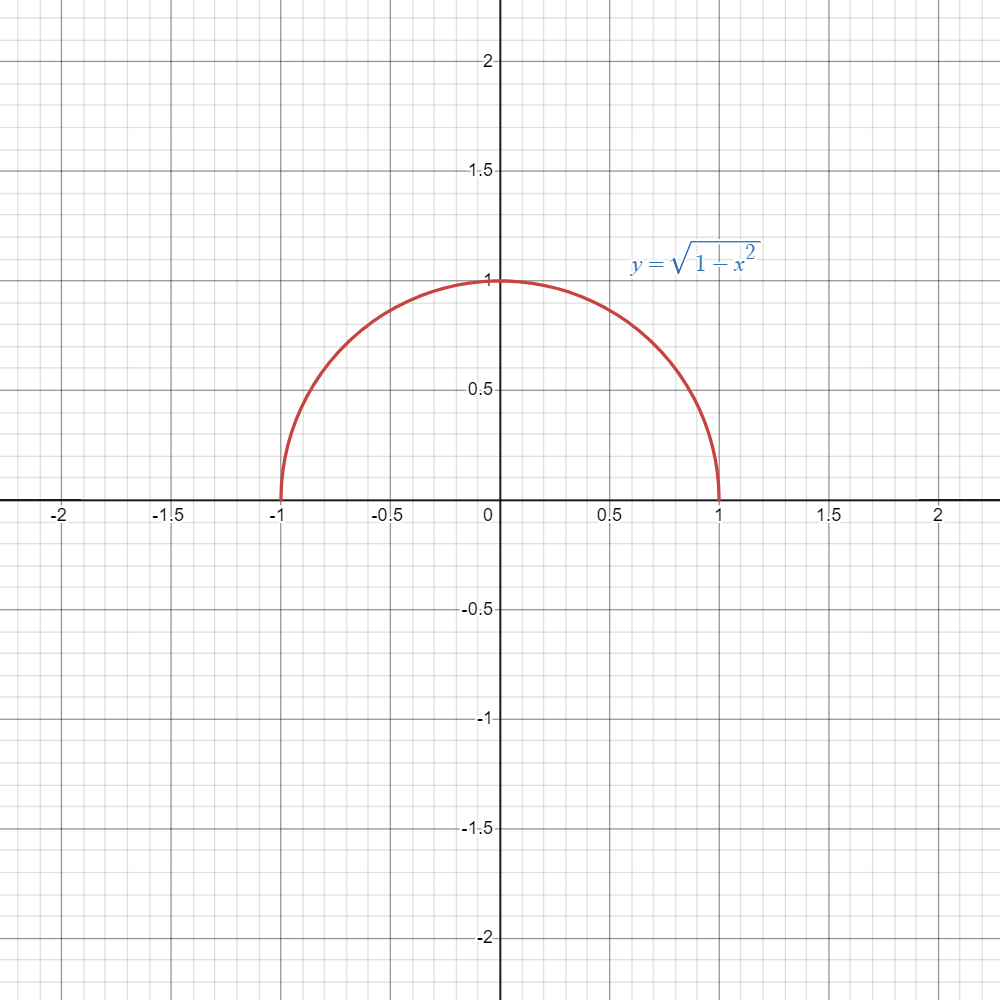
For instance, consider the graph of the function
. 
-
From this graph, we can observe that the only possible inputs
for this function ranges from to , including and themselves. - Therefore, we can express the domain of
as all values over the interval .
- Therefore, we can express the domain of
-
From observing this graph as well, the possible outputs
of this function goes from to as well, including and themselves. - Therefore, we can express the range of
as all values in the interval .
- Therefore, we can express the range of
-
The domain and range of a function are usually written as a set, and therefore we write them in set builder notation.
- Therefore, the domain of
can be formally defined as . - And the range of
can be formally defined as .
- Therefore, the domain of
Definition
Set Builder NotationThe set builder notation is a method of defining sets with infinite elements, and exist over an interval of values. They are often used to represent the domain and range of a function.
The domain of a function written in set notation can be expressed as:
The range of a function written in set notation can be expressed as:
or alternatively:
- To clear up the intricacies of this notation:
- The
or part indicates that the domain or range is in the set of real numbers - This means that the domain also includes both rational and irrational numbers as well.
- The condition for
or can either be an interval like or a restriction like . - We can also not include a condition or restriction to prove that a set includes all real numbers.
- There can also be two or more non-overlapping conditions
- The
Worked Example
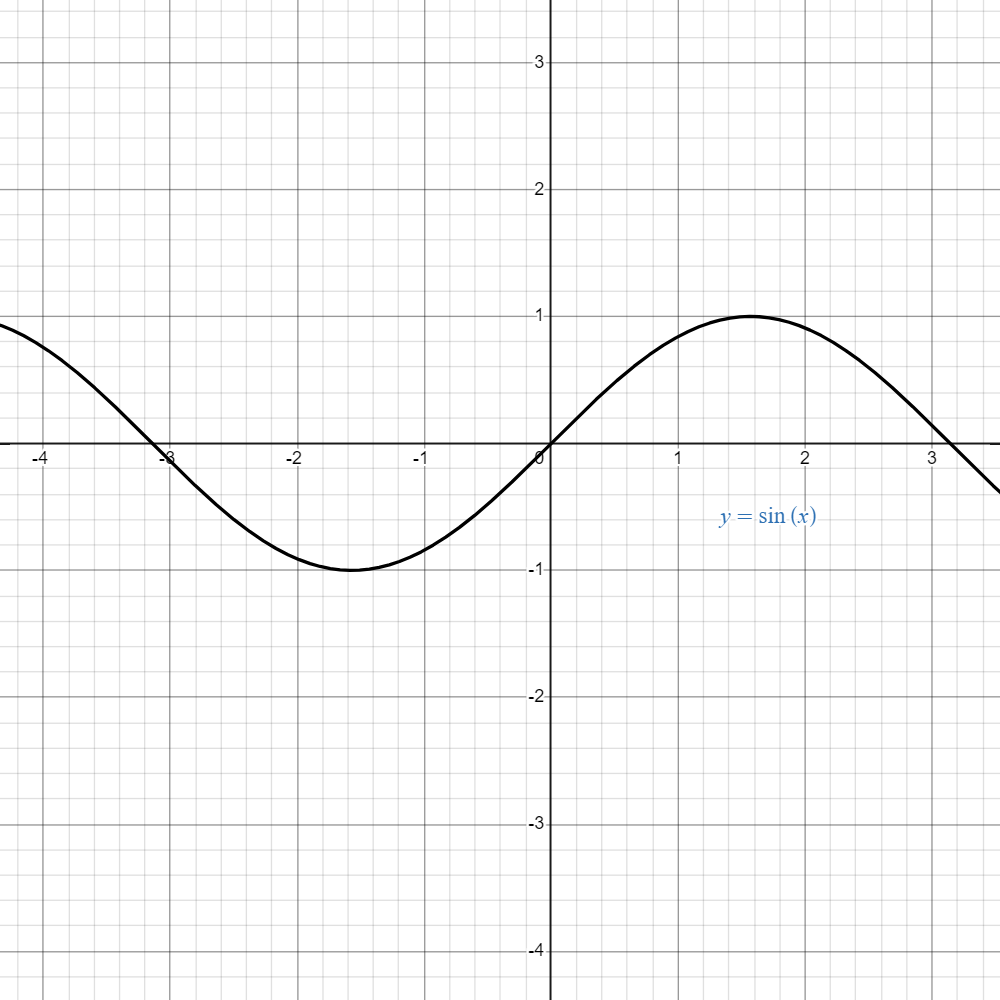
Finding the Domain and Range of a Function from a Graph using Set NotationUse the graph below to estimate the domain and range of
.
Solution
The possible input values seems to extend indefinitely towards
and , therefore, the domain of includes all real numbers. We can express this as:
Notice that we don’t put any restrictions or conditions to show that it includes all real numbers
As for the range, the possible output vales seems to oscillate from
to , therefore, the range of is:
-
When we find the domain and range of a function, it is often assumed that we are always dealing with the set of real numbers.
- Therefore, the
or part in set notation becomes repetitive. - Often, the interval notation fixes this conundrum.
- Therefore, the
-
The interval notation is written as follows:
- The smallest number,
, is written first, then followed by a comma. - Then the largest number,
is written second, after the comma. - We use parentheses
or to signify that the endpoint value is not included. - We use brackets
or to signify that the endpoint value is included.
- The smallest number,
| Description | Inequality/Restriction | Interval Notation | Graph |
|---|---|---|---|
| no restriction; all real numbers |  | ||
 | |||
 | |||
 | |||
 | |||
not including |  | ||
 | |||
 | |||
including |  |
Note
When writing interval notation with unbounded endpoints, that means intervals with endpoints at infinity, such as the ones below:
We always use a parenthesis as a number cannot ever be equal to
or .
Worked Example
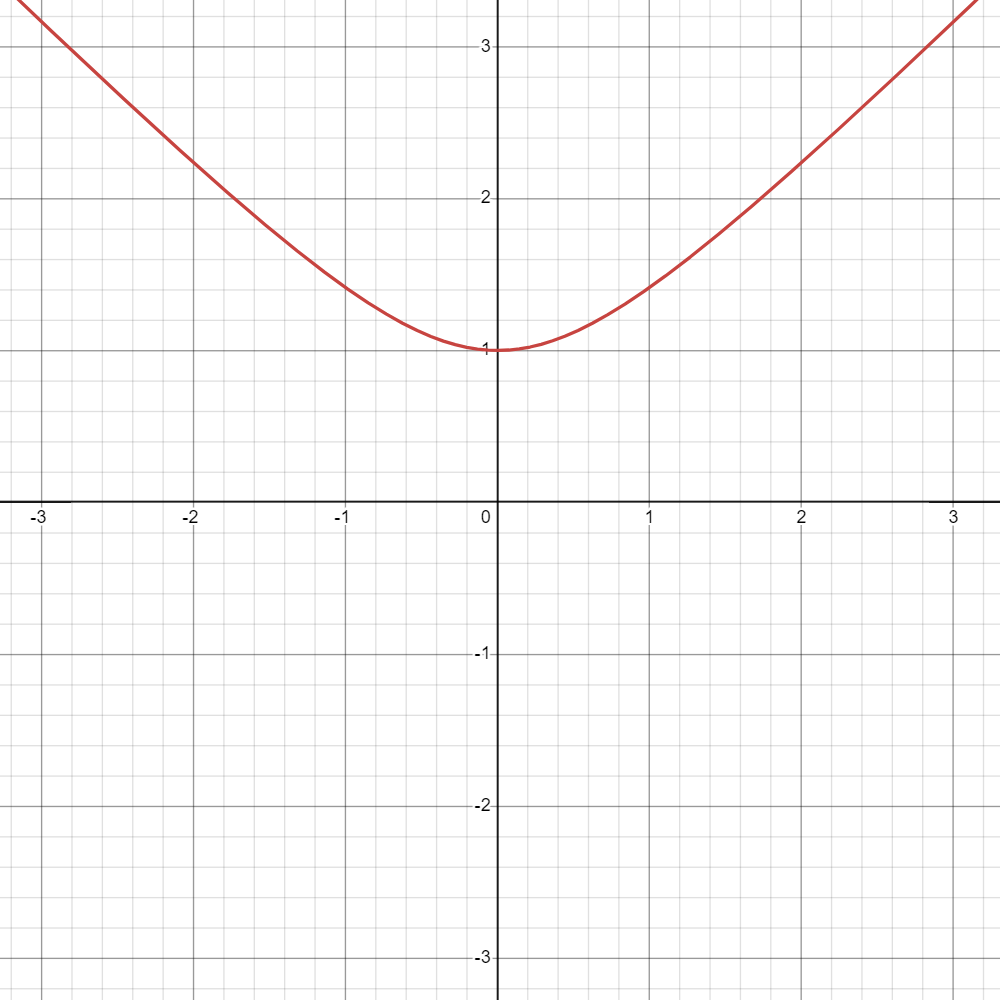
Expressing the Domain and Range of a Function from its Graph with Interval NotationThe graph of
is displayed below.
Use the graph to estimate its domain and range. Express your answer in interval notation.
Solution
From its graph, we can say that it can accept any possible input.
This is because we can square any number, addand then take its positive square root. Therefore, the domain of this function is:
However, the set of possible outputs does not go below
and it extends indefinitely towards . This indicates that the range of the function is . In interval notation, the range of this function is:
- Some functions may have domains or ranges that cannot be defined by a single interval.
- In such cases, we use the union operator
to combine two conditions or intervals. - For instance, the restriction
can instead be expressed as and . - Therefore in interval notation, we can translate this to
.
- Therefore in interval notation, we can translate this to
- In such cases, we use the union operator
| Description | Inequality/Restriction | Interval Notation | Graph |
|---|---|---|---|
| all real numbers, not including |  | ||
| all real numbers, not including |  | ||
 | |||
 |
What is a Rational Function?
- A rational function can be defined as a function that contains at least a single rational expression.
- More generally, it is defined as a function that can be written as a quotient of two polynomial functions
and .
- More generally, it is defined as a function that can be written as a quotient of two polynomial functions
Definition
Rational FunctionA rational function is any function that can be represented as a quotient of two polynomial functions,
and .
- This definition of a rational function allows us to distinguish other functions that is a quotient of two functions, but are not rational.
- For example, the functions below are not rational functions as the numerator and denominator is not made up of a polynomial function
- Some functions might not look like a rational function, but they can be written as one.
Domain of a Rational Function
- We now know from the previous lesson that it is not possible to divide by 0.
- Therefore, when considering the domain of a rational function
, our denominator must not equal to . - Therefore, by solving when the denominator equals zero, the solution set makes the function undefined.
- We can then exclude these values to form our domain.
- Therefore, when considering the domain of a rational function
Worked Example
Finding the Domain of a Rational FunctionFind the domain of the rational function
. Solution
First, we locate the denominator, which is
.
Then, we find values forwhen is equal to . Since the solution set is
, we then exclude it to our domain.
Therefore, the domain ofis: or in interval notation, .
Worked Example
Finding the Domain of a Rational Function with FactoringFind the domain of the rational function
. Solution
To find the domain, we first retrieve the denominator
.
Then, we find for values ofwhere is . Using zero product property, we can divide these into individual cases by equating when each of these factors equal zero. Recall that:
Zero multiplied by anything is zero, so if one factor is zero, then everything else must be zero
- For
:
- For
:
- For
: Therefore, the domain of
is:
in set notation or, in interval notation.
- In some cases, some algebraic manipulation is required.
- This may be either adding or subtracting the rational expressions themselves, or using the quadratic formula.
Worked Example
Using the Quadratic Formula in Finding the DomainFind the domain of the rational function
. Solution
First, we let the denominator
equal to . To solve this, we can use the quadratic formula.
Therefore, the domain is:
in set notation, in interval notation.
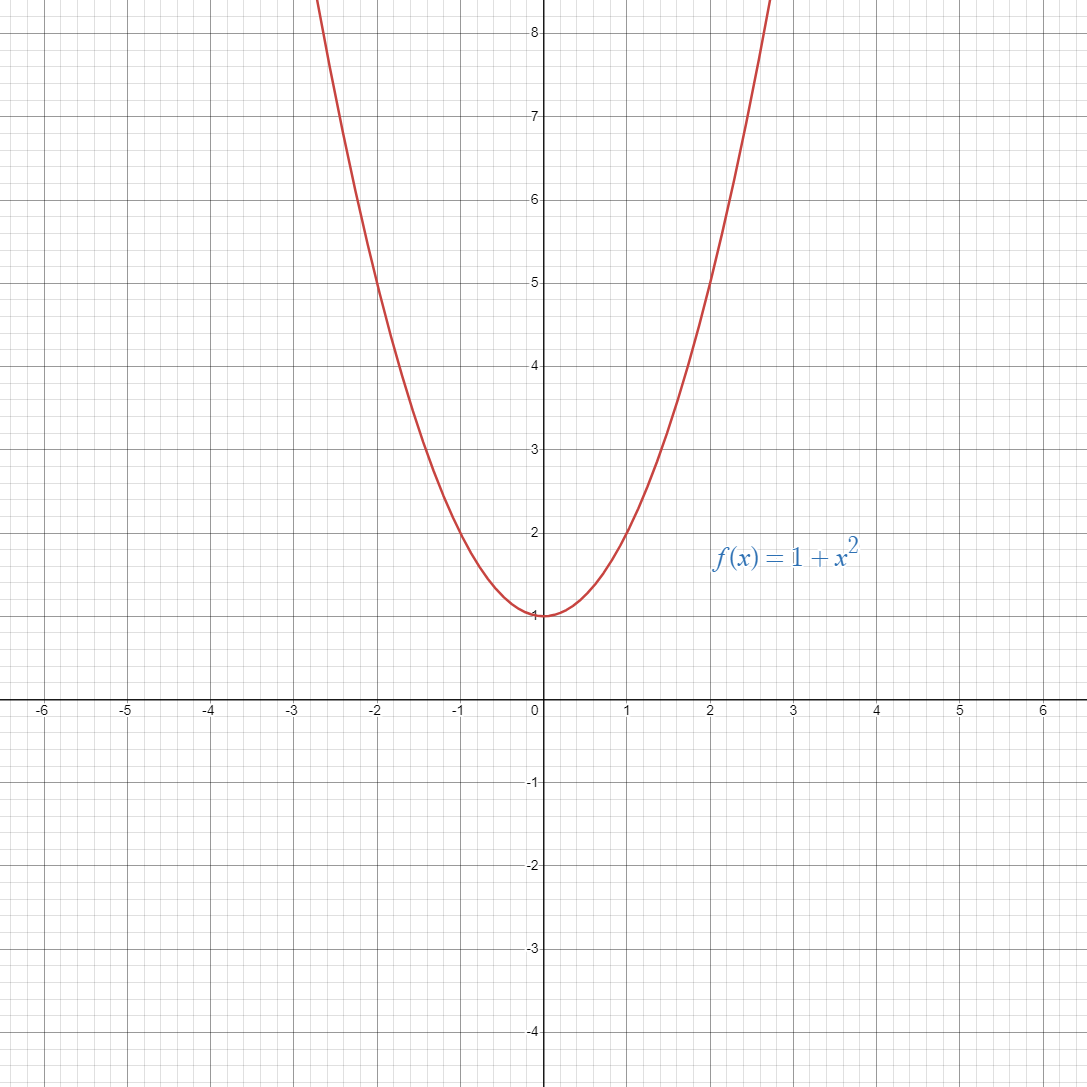
- Not all rational functions have restrictions in their domain.
- For instance, consider the function:
- This function is defined for all real numbers.
- This is because there is no
that will make equal to zero. - In fact, its graph does not even touch the
-axis
- This is because there is no
General Instructions
Domain of a Rational FunctionTo find the domain of a rational function:
- Set the denominator equal to zero.
- Exclude the solution set in the domain.
- Express your answer in any notation you prefer.
Range of a Rational Function
- As for the range, the process works for the same way, but we have to do some more work.
- For example, consider the function:
- First, we express the function as an equation for
. - This can be done by replacing the function notation
into .
- This can be done by replacing the function notation
- Then, we swap the
and variables.
- Then, we solve for
. - This can be done by grouping all
terms in one side, then factoring them.
- This can be done by grouping all
- This resulting function is the inverse of the function
. - By finding the domain of this inverse function, we get the range of our original function
. - Getting the domain of the inverse function we get:
- Therefore, the range of
is in set notation. in interval notation.
General Instructions
Finding the Range of the Rational FunctionTo find the range of the rational function
:
- Express the function as an equation by letting
. - Then, find its inverse by swapping the
and variables. - Solve the equation in terms of
. - Find the domain of the resulting inverse function using methods in the previous section.
Worked Example
Finding the Range of a Rational FunctionFind the range of the function
. Solution
First, let us express the rational function as a single rational expression.
We can do this by adding the two rational expressions using the methods discussed in Rational EquationsThen, we find its inverse.
Finding the domain of the inverse function, we see that:
Therefore, the range of
is:
in set notation, in interval notation.
Work in Progress!
The content beyond this section contains some missing information that might be essential in fully understanding the topic.
Warning
The content beyond this section assumes that you know:
- Domains of Radical Functions
- Complex Numbers
- Quadratic Inequalities
-
Finding the range of a rational function is a cumbersome process.
- This is because the process gets a little more difficult when we consider cases with a quadratic denominator or a higher degree denominator.
-
For instance, consider the domain of the function:
- We can still apply the basic concepts of finding the range earlier.
First, we express the function as an equation of, then we swap the variables.
- Then, we multiply both sides by whatever is in the denominator,
. - We can then apply some algebraic manipulations
- Since we have a
term, and we wanted to isolate the term, we can then use the quadratic formula. - To apply the formula, we must write our equation as
- To apply the formula, we must write our equation as
- We then now retrieve the coefficients for the quadratic formula.
- Since we are solving for
, we can say that and . - Since
is the only term without a term then we set it as the constant term .
- Since we are solving for
- Applying the quadratic formula, we get:
- By using the quadratic formula, we isolated
in one side of the equation. - Now we can analyze its domain.
- The only way this function would be undefined is if:
- The denominator
is . - The radicand inside the square root
becomes negative.
- The denominator
- The only way this function would be undefined is if:
- Using the conditions we provided from its inverse, we now have the range restrictions of our original function
.^range-restriction
- As for
:
- As for
, we apply the rules of quadratic inequalities
- This inequality will only satisfy when either
or .
Solving for:
- Solving for
:
- Solving this inequality, we get that the range of our original function,
, must be for all real numbers. - In set notation, it is
- In interval notation, it is
- In set notation, it is
- But what about the
that we got from the original range restrictions? - It turns out that this is the horizontal asymptote of our original function.
- This will be discussed in more detail in the next few sections.
Worked Example
Finding the Range of a Rational Function with a Quadratic DenominatorFind the range of the rational function
Solution
To find the range, we first express our function as an equation of
. Then, we proceed by finding its inverse.
First, we swap theand variables. Next, we solve for
.
Since the variableis a second degree term, we prepare to use the quadratic formula.
But first, we should rewrite it in the form. We then apply the quadratic formula in terms of
.
Since we are solving for, then the coefficients for , , and are:
Substituting the coefficients gives us:
We can treat this as the inverse of our original function
.
Examining its domain should give us the range of.
This can be done by finding the values where the radicandis positive. Applying the rules of quadratic inequalities:
- Since
is a downward parabola, it can only be in the interval , where and and are the roots of the quadratic expression. Therefore, the range of the original equation
is:
in set notation in interval notation.
- In some cases, the range of a function might be defined for all real numbers.
- Consider the example:
- The first step is to find the inverse of
. - We can do this by expressing the function as an equation of
, swapping variables, manipulating the equation into , then applying the formula. - The resulting inverse function should give us:
- By solving for the domain of this function, we can find the range of our original function
.
Finding where the radicand:
is an upward parabola. - The only way that this inequality is satisfied is if the smaller root
and the larger root . - Using the quadratic formula to compute the roots, we can now begin to solve the inequalities:
- The only way that this inequality is satisfied is if the smaller root
- Since the restrictions are complex numbers (the radicand is negative in the square root sign), therefore, we can conclude here that the range of
is the set of all real numbers.
Strategy
Finding the Range of a Rational FunctionThe strategy for finding the range might be a little different depending on the degree of the denominator.
If the degree of the denominator is linear:
- Express the function
as an equation of . - Find the inverse of
by swapping the and variables. - Solve for
by multiplying both sides by the denominator. - Rearrange so that all
terms are in one side of the denominator. - Factor the expression by
. - Then, divide both sides by the factored expression to find the inverse of
and to isolate on one side of the equation. - Find the domain of the resulting expression to get the range of
. - Express it in set or interval notation.
If the degree of the denominator is quadratic:
- Express the function
as an equation of . - Find the inverse of
by swapping the and variables. - Solve for
by multiplying both sides by the denominator. - Rearrange so that it takes the form
. - Apply the quadratic formula to isolate
and to get the inverse of . - Find the domain of the resulting expression to get the range of
.
- You may want to use rules of quadratic inequalities to find its domain.
- You may need to use the quadratic formula again to find the roots.
- If the restriction is a complex number, that means that the range is all real numbers.
- Express it in set or interval notation.
Zeroes of Rational Functions
- The zeroes of a function
is a set of input values , where:
- In short, they are certain values where the function is equal to zero.
- However in a rational function, the only reasonable way where a function equals zero is when the numerator is equal to zero.
- So, if a rational function can be expressed as:
\
- So, if a rational function can be expressed as:
- If
, then it follows that, . - Be ware that
cannot be equal to zero. - Any value that makes
is not included as a zero of a rational function, regardless if is also .
- Be ware that
Definition
Zeros of Rational FunctionsA zero of a rational function
is any input value , where it satisfies the equation: The zeros can be found by finding values where the numerator
but does not result in a division by zero, or when the denominator .
- But what’s the difference between a zero and an
-intercept? - The zero of a function is an actual numerical value, while an
-intercept is an actual point in the coordinate plane that intersects the -axis. - One key idea is that if
is a zero of a function , then is an -intercept of
- The zero of a function is an actual numerical value, while an
Definition
-intercept of a Rational Function An
-intercept of a rational function is a point on the coordinate plane where the graph of crosses or intersects at the -axis, where the value is a zero of the rational function .
Worked Example
Zeros of Rational FunctionsFind the zeroes of the rational function
. Solution
First, we solve when the numerator is equal to zero.
Solving the polynomial with zero product property, we get the values
.
Notice that from our solution set, when we substituteto our denominator , we get:
makes the function undefined, so it does not belong as the zeros of
Therefore, the zeros of the rational functionare
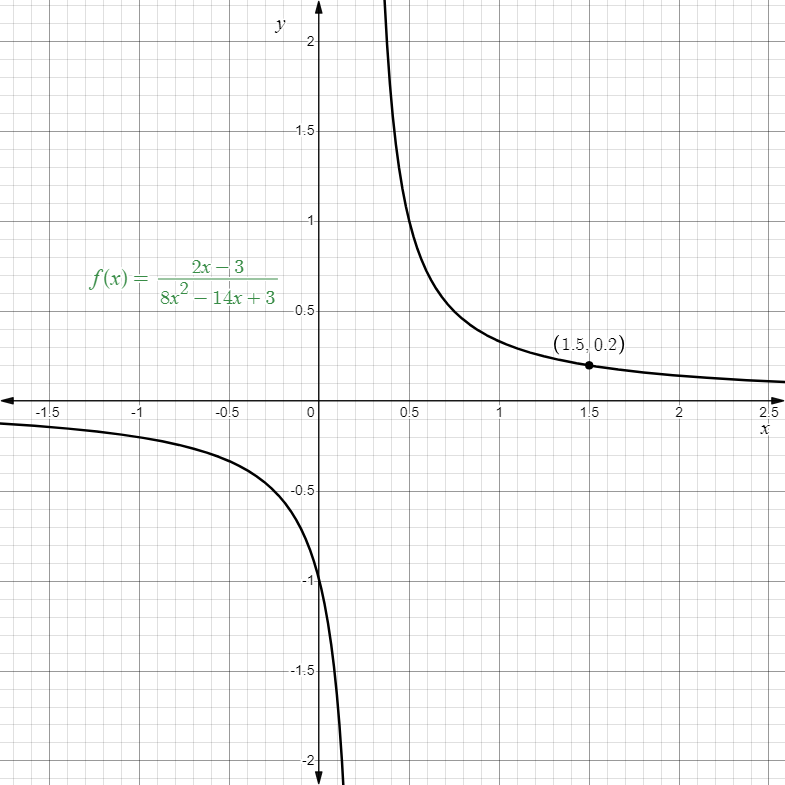
It also follows that the-intercepts of are and . We can see this as we graph
:

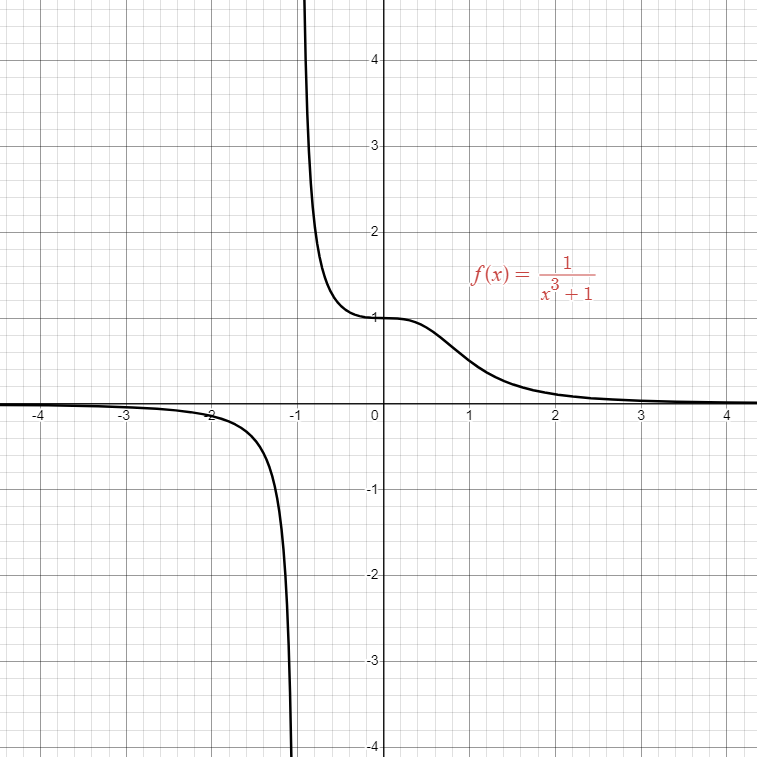
- It is also possible that a rational function does not have any zeros or
-intercepts due to restrictions in their range. - For example, consider the function
- Since the numerator is a constant
, then it can never be equal to . - Therefore, it does not have an
-intercept.
- Therefore, it does not have an
- We can observe this by looking at its graph.
- For example, consider the function
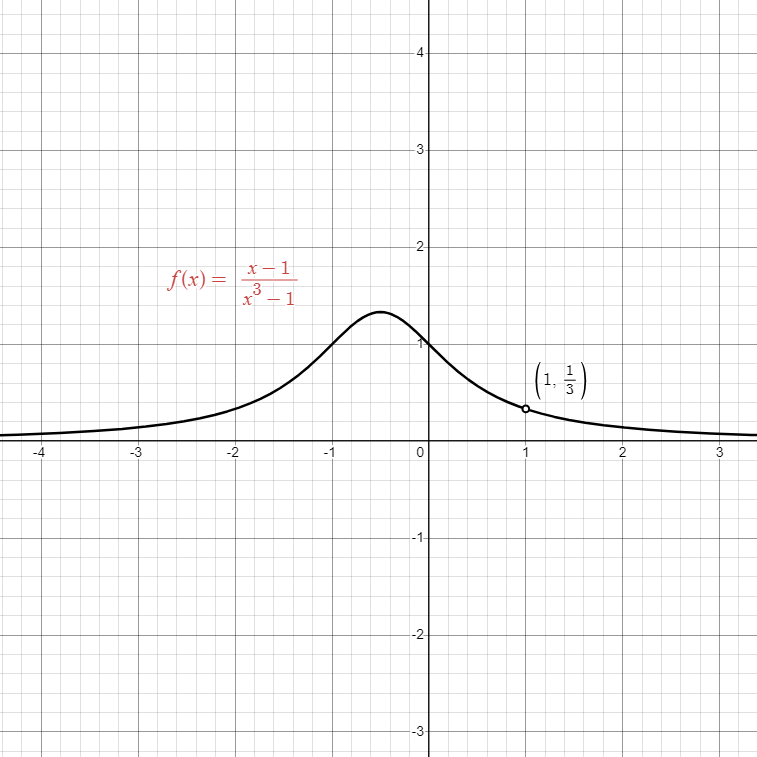
- Some rational functions may look like they have
-intercepts but they do not. - Consider the function
- At first glance, we might say that
is a zero of . - Upon closer inspection, we can see that
. - Therefore, this function does not have any
-intercepts. - We can see that this is the case when we graph
.
- Consider the function
Strategy
Finding Zeroes and-intercepts of Rational Functions If
can be expressed as a rational function in the form: Then, use the following strategy to find zeroes of rational functions.
- Solve when
.
- If
cannot be equal to , then there are no zeroes or -intercepts as well. - Check your answer by substituting the zeros
back to the original function.
- If
then it is not a zero of the rational function. - Express your answer as
to find the -intercepts.
- The
-intercept is the point at which the function crosses the -axis. - In other words, it is the value of the rational function at
.
- In other words, it is the value of the rational function at
Definition
-intercept of a Rational Function A
-intercept of a rational function is the point where the function crosses the -axis. It can be found by simply evaluating .
Worked Example
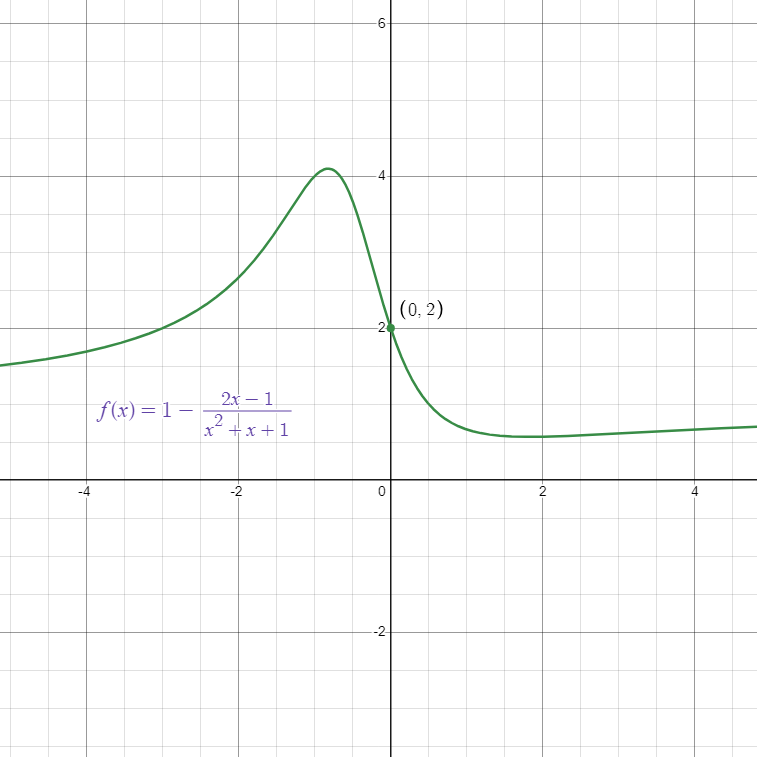
-intercepts of Rational Functions Find the
-intercept of the rational function Solution
To find the
-intercept of a rational function, we simply evaluate . Therefore, the
-intercept is
We can see that this is the case when we graph the function itself.
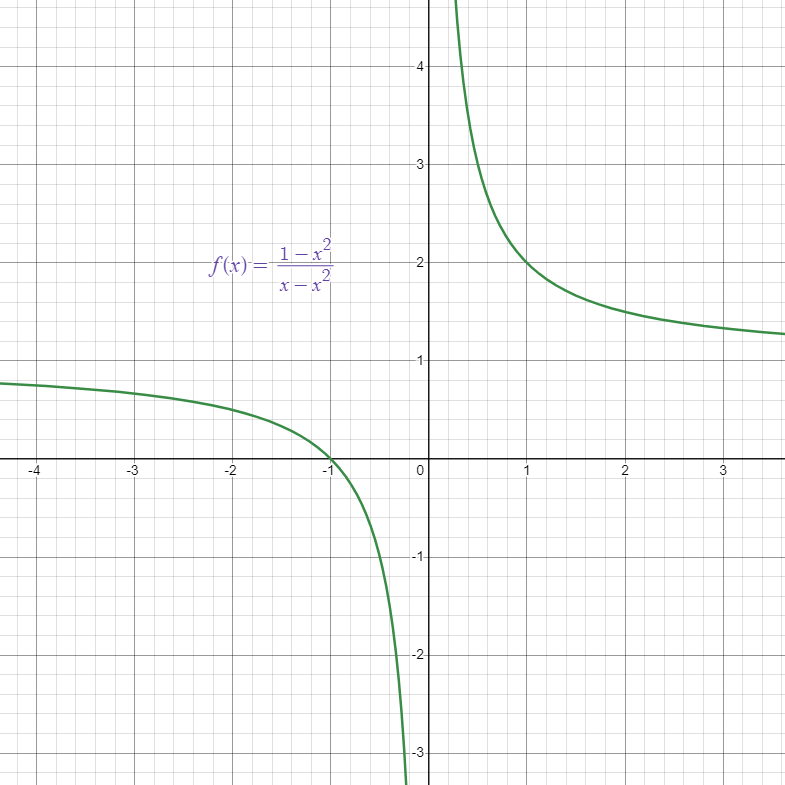
- Note that not all rational functions have a
-intercept. - Take for instance the function
. - Since
, therefore is undefined. - The graph shows us that there is no
-intercept.
- Take for instance the function
Asymptotes of Rational Functions
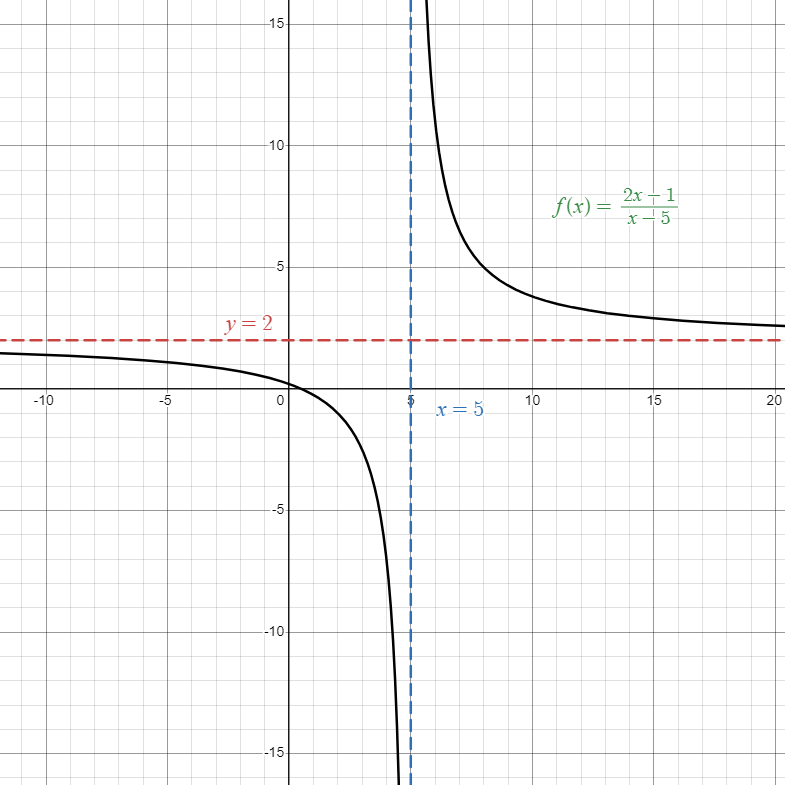
- An asymptote is a line that a function approaches as it gets closer and closer to a certain value.
- For instance, consider the graph of the function
below:
-
Here, we see two types of asymptotes: a vertical and a horizontal asymptote.
- As the input
gets closer to , the behavior of the graph gets closer to the vertical line . - At the same time, as the input
gets closer to or , the value of the function approaches .
- As the input
-
We can see here that the graph of
never crosses the lines and . -
There can be three types of asymptotes: vertical, horizontal, and oblique.
Vertical Asymptotes
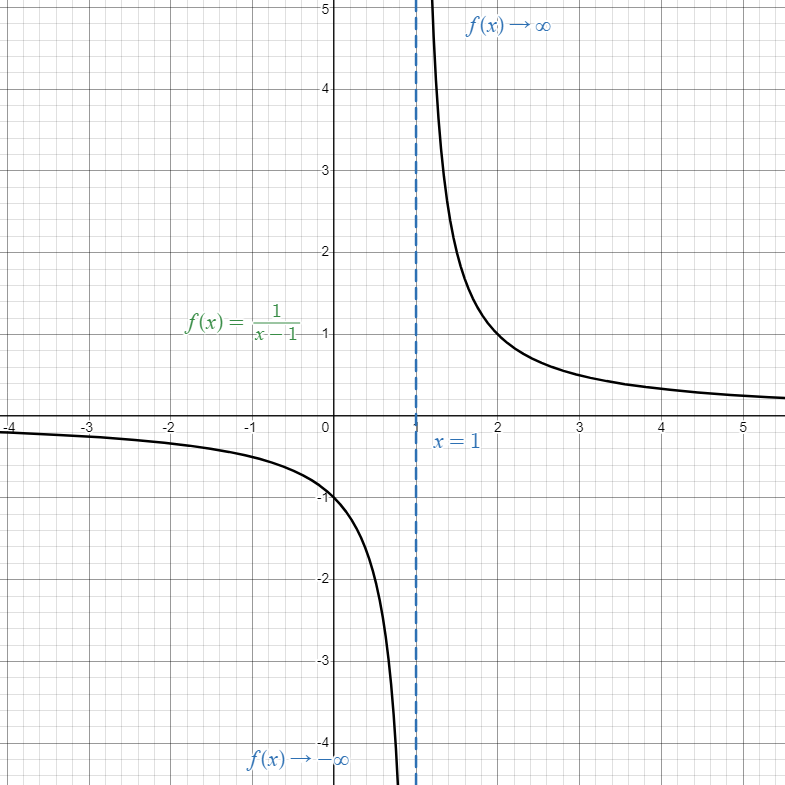
- A vertical asymptote is a vertical line
that the rational function never crosses. - One intrinsic property of this asymptote is that as the input
approaches the value , approaches or on either side of the asymptote
Definition
Vertical AsymptoteA vertical asymptote is a vertical line
that the graph of a function never crosses. For values near a vertical asymptote, the graph of a rational function tends to approach
or on either side of the asymptote.
- In a rational function, vertical asymptotes only occur on input values that result in a division by zero.
\
Definition
Vertical Asymptote of a Rational FunctionGiven a rational function expressed as a quotient of two polynomials:
A rational function has a vertical asymptote at
if and only if it:
Worked Example
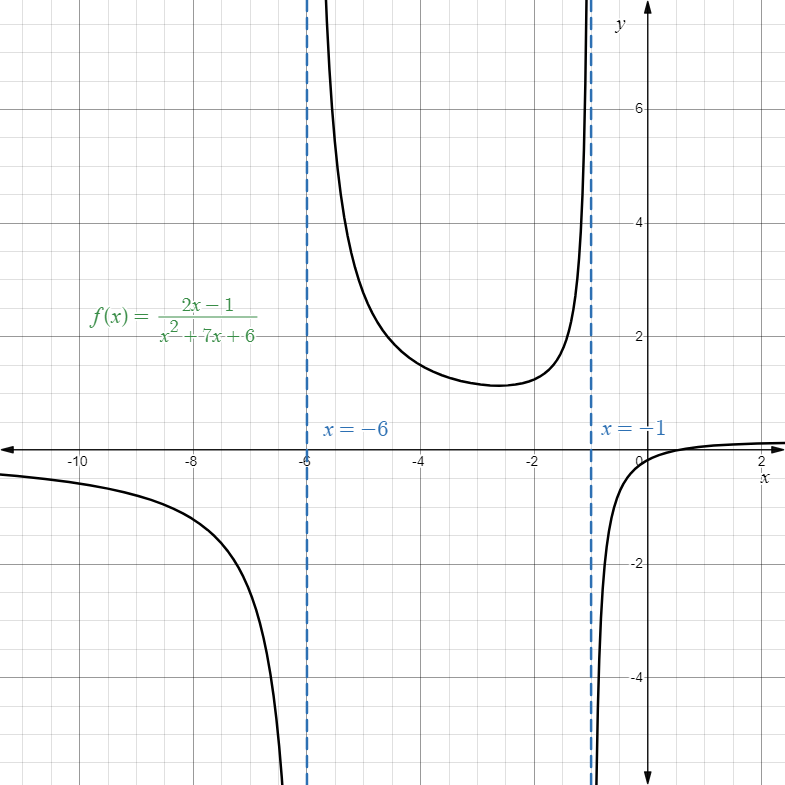
Finding Vertical Asymptotes in a Rational FunctionFind the vertical asymptotes of the function
Solution
To find the vertical asymptotes of
, we need to find the values where the denominator . Using zero product property, we get the equations
or .
Solving them gives us the vertical asymptotes of, namely and .
Substituting these values back to our original function, we see that it results to a division by zero:
. These values are known to have removable discontinuities.
While they make the denominator zero, they do not result in a vertical asymptote.
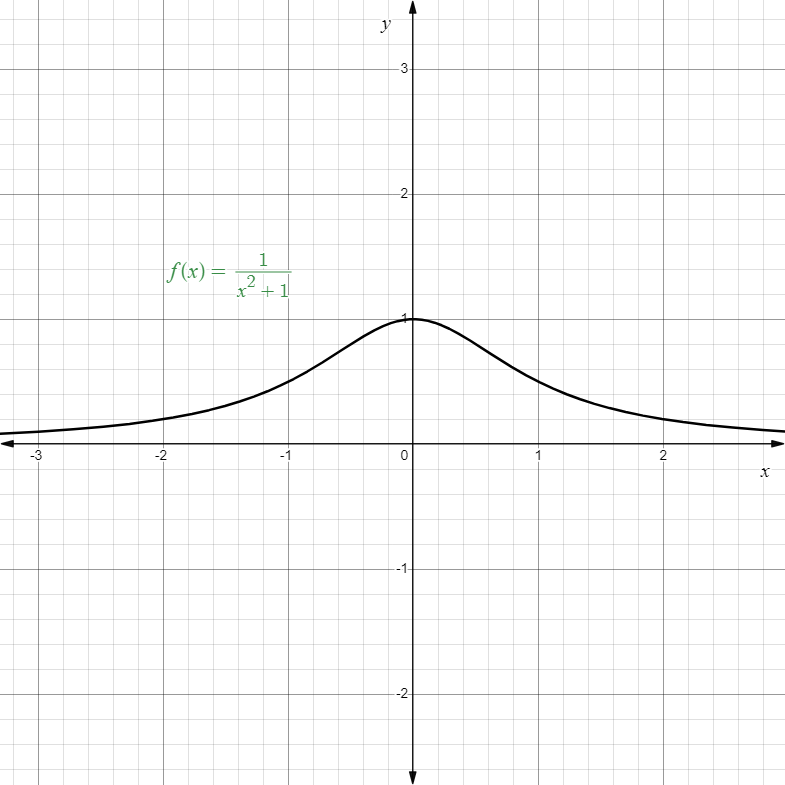
- There are some cases where the expression in the denominator cannot be equal to
. - These are the cases where a rational function might not have a vertical asymptote.
- For instance, consider the function
. - Since
cannot be equal to , therefore, it does not have a vertical asymptote. - This is evident when we take a look at its graph.
- Since
Worked Example
Finding Vertical Asymptotes in a Rational Function with Removable DiscontinuitiesFind the vertical asymptotes of
. Solution
First, we find where the denominator
equals . The only way that the denominator is zero is when
.
Sincedoes not have any roots, therefore, the equation does not have any real solutions. Solving when
gives us .
Substitutingto our original function gives us: The input value
results in a , therefore, it has a removable discontinuity at that point.
Since there are no other possible factors that can equal zero, we can say thathas no vertical asymptotes. Analysis
Without solving and checking for the domain, we can immediately know that this function does not have any solutions.
First, we factor the numerator and the denominator.
Since we have an
in both the numerator and the denominator, we can cancel it.
This eliminates any removable discontinuities in the function.Checking the denominator,
cannot be equal to zero as established and therefore, we can tell that does not have any vertical asymptotes.
Horizontal Asymptotes
- Just like vertical asymptotes, a horizontal asymptote is a horizontal line at which the graph of a rational function never crosses.
- Coincidentally, it is also the value that
approaches as approaches or .
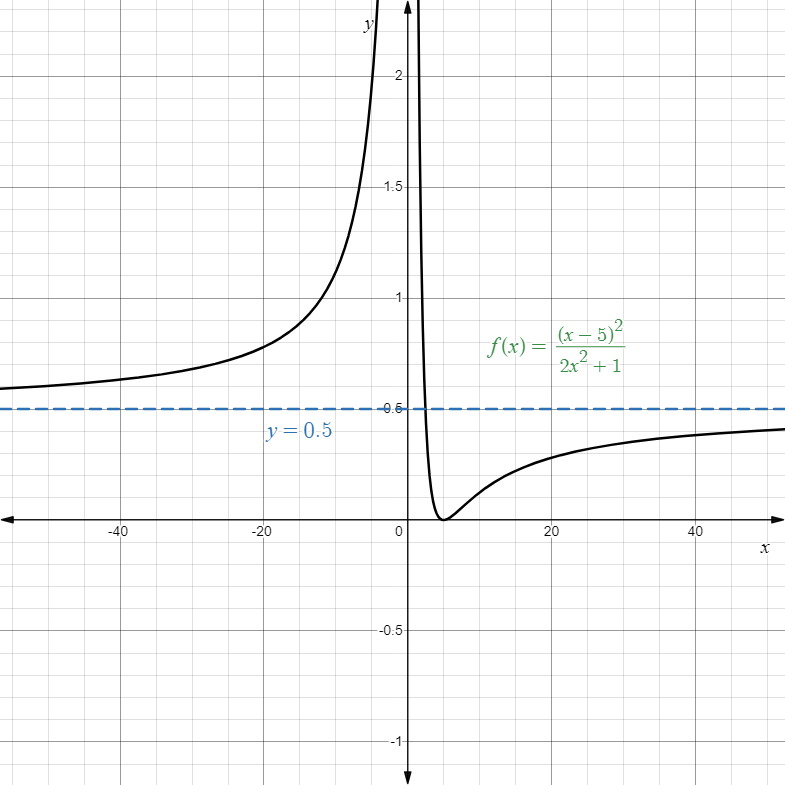
Definition
Horizontal AsymptoteA horizontal asymptote is a horizontal line
at which the graph of a function approaches as approaches or . Unlike the vertical asymptote, the function may or may not cross the horizontal asymptote.
-
Suppose that the rational function
. -
To find horizontal asymptotes, we use polynomial division.
- When using polynomial division, we ensure that the degree of the numerator is greater than or equal to the degree of the denominator.
- If the degree of the numerator,
is less than the degree of the denominator , then we cannot divide and the horizontal asymptote is .
-
If the degree of the numerator
is equal to the degree of the denominator , the horizontal asymptote is the quotient of and .
Worked Example
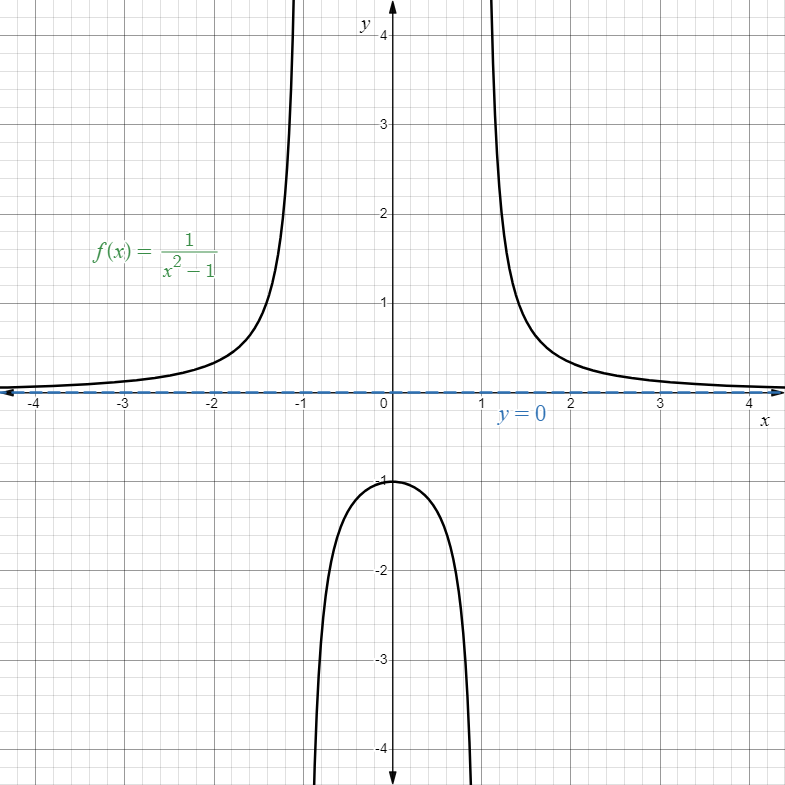
Finding the Horizontal Asymptote of a Function 1Find the horizontal asymptote of the function
Solution
Since the degree of the numerator,
is and the degree of the denominator , we cannot divide and so the horizontal asymptote of is .
Worked Example
Finding the Horizontal Asymptote of a Function 2Find the horizontal asymptote of the function
. Solution
Since the degree of the numerator
, and the degree of the denominator , we can use polynomial division to find the horizontal asymptote. Since the quotient is
, the horizontal asymptote is .
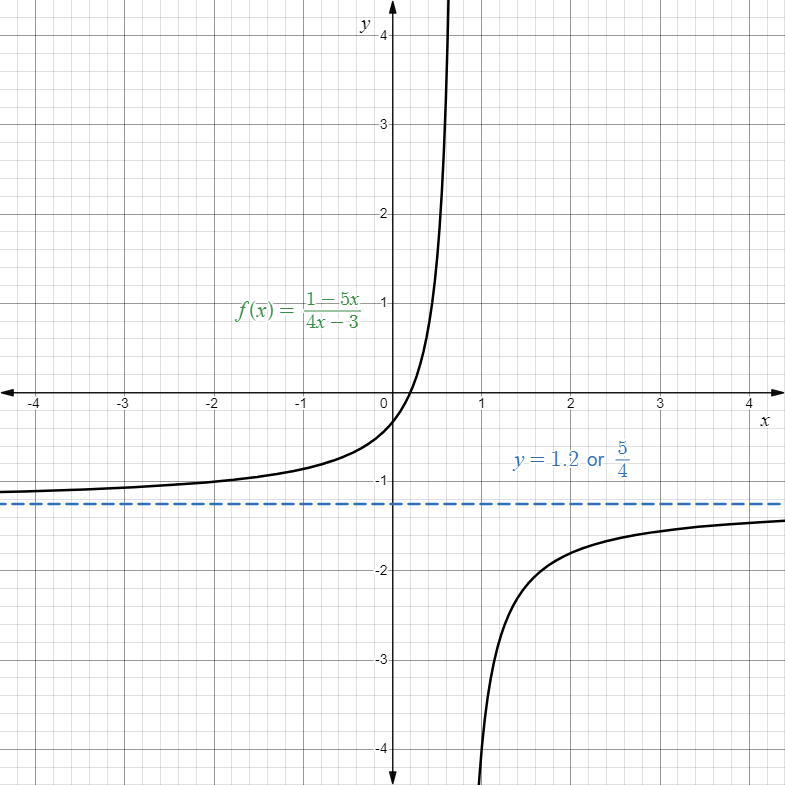
- In general, we can only have a horizontal asymptote if the degree of the numerator is less than or equal to the degree of the denominator.
- We can now generalize the conditions for a horizontal asymptote of a rational function.
Definition
Horizontal Asymptote of a Rational FunctionGiven a rational function
that can be expressed as a quotient of two polynomials A rational function has a horizontal asymptote if it satisfies these conditions:
- If
, then the horizontal asymptote is . - If
, then the horizontal asymptote is where
is the degree of the polynomial function . If
, then there is no horizontal asymptote.
Oblique Asymptote
- An oblique asymptote is an asymptote that is neither a vertical line or a horizontal line.
- It is a straight line that a rational function approaches for larger values of
- For instance, consider the rational function:
- Using polynomial division, we get:
- Therefore, its oblique asymptote is
. - We can see that for larger values of
, the rational function approaches the line .

Definition
Oblique AsymptoteAn oblique asymptote is an asymptote that is neither a vertical line or a horizontal line.
It is a slanted line that a rational functionapproaches as approaches or . An oblique asymptote only occurs if
.
The quotient of the numerator and the denominator in polynomial division determines the equation of the oblique asymptote of the rational function.
Removable Discontinuities
- A removable discontinuity is a point in the graph of a function
where is undefined. - In other words, it is a “hole or a gap in the graph” where the function is undefined.
- For instance, consider the function:
- Observing the domain of the function from its denominator
, this function must be undefined at and . - Therefore, we should expect an asymptote at the lines
and .
- Therefore, we should expect an asymptote at the lines
- Upon graphing this function, we see that:
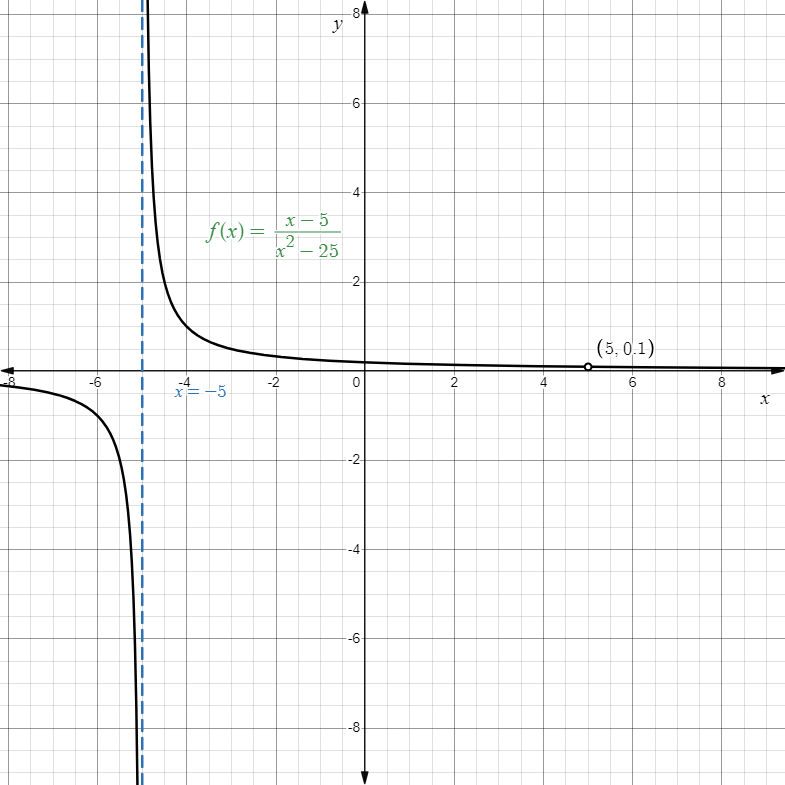
- Instead of an asymptote, we see a hole in the graph at
. - This hole indicates that it is still undefined at that point.
Definition
Removable Discontinuities.A removable discontinuity or a point discontinuity is a single point in the graph where the function is undefined.
It is different from a vertical asymptote that it does not approach
or as the behavior of the graph approaches the point. In a way, it is called “removable” as we can simply remove them and fill them so that the graph is continuous in that single point.
- One thing that we can do is to identify where a removable discontinuity might occur.
- In our previous example, we can simply factor our denominator into
. - We can now see an
in both the numerator and the denominator.
- In our previous example, we can simply factor our denominator into
- By cancelling this, we get the same exact graph, except without the hole in
.
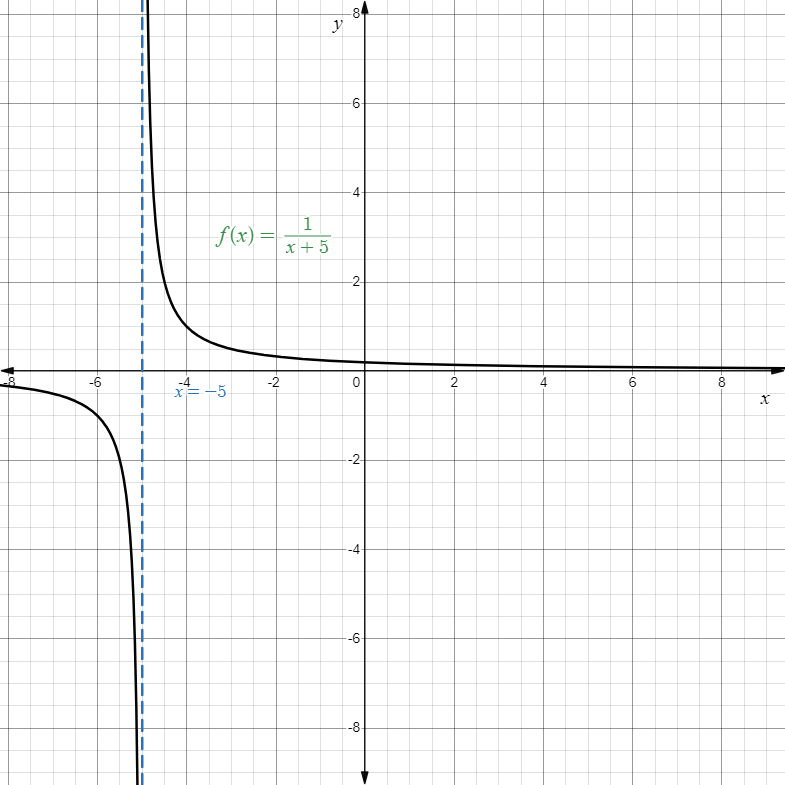
- This way, we can remove the discontinuity on the original function by simplifying it first, then evaluating the point discontinuity on our simplified expression.
Worked Example
Locating Point DiscontinuitiesFind any removable discontinuities in the rational function
. Solution
First, factor the numerator and the denominator.
We can see the factors
, and are present in both the denominator and the numerator. Equating them to
will allow us to find where are they located.
is our first point discontinuity. - Solving
gives : the second point discontinuity. - Solving
gives : the third point discontinuity. Therefore, we have a discontinuity at
.

Worked Example
Removing Point DiscontinuitiesFind and remove the point discontinuity on the function
Solution
First, we factor the denominator.
Since it is a quadratic with a leading coefficient that is not, we use factoring by grouping. Substituting the factored expression, we get:
Since we have a
in both the numerator and the denominator, then we have a removable discontinuity at the point where .
Solving forgives us : the location of our point discontinuity. Going back to our original function, we can now cancel
to get: Finding
should give us the point discontinuity Therefore, the exact location of the discontinuity is at
or at .